The Blueprint: The Brain Behind Your Revenue Agents


The Blueprint: The Brain Behind Your Revenue Agents
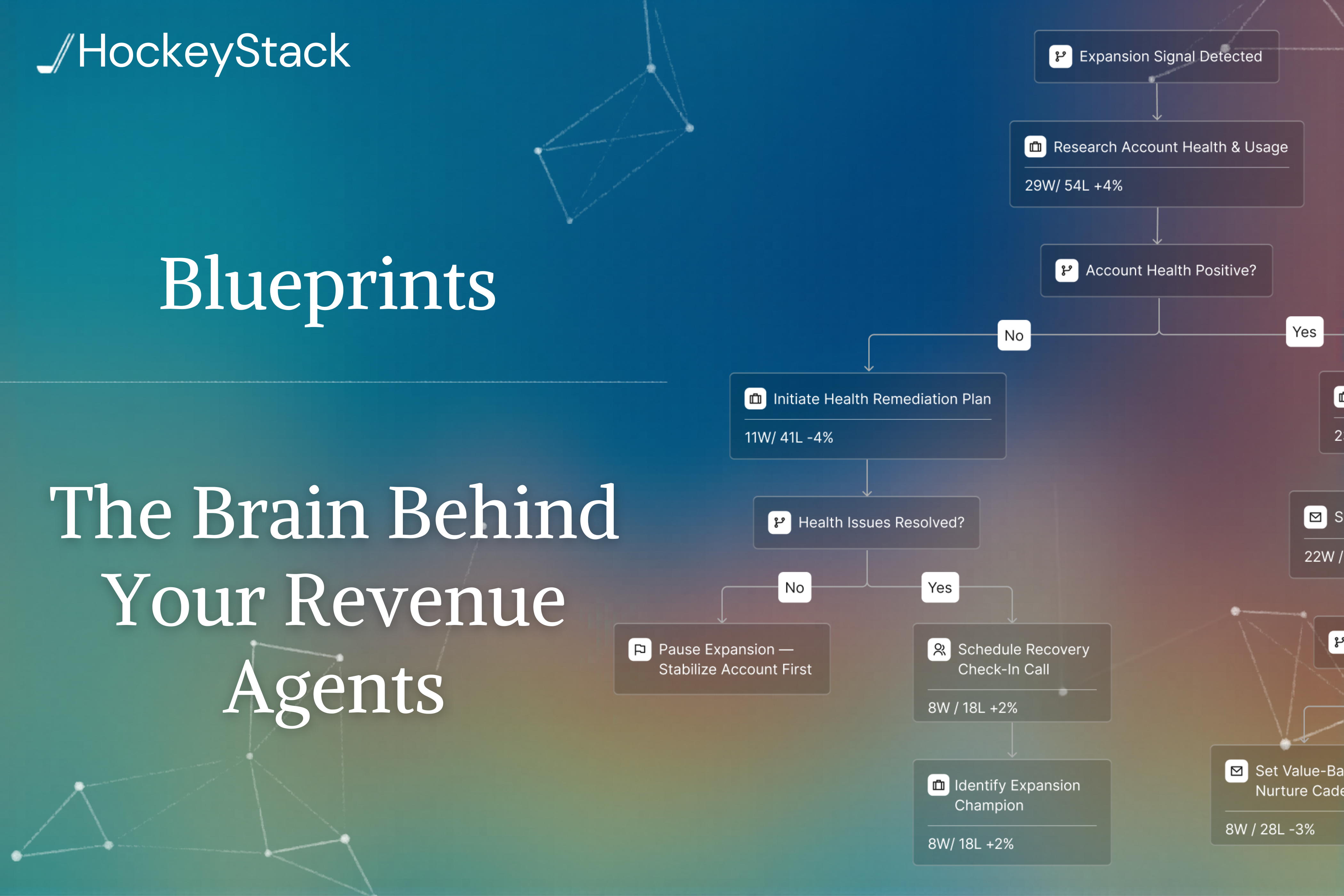
The best sales reps have moments of greatness driven by instinct that no playbook has ever been able to capture. HockeyStack deploys Revenue Agents to execute those winning patterns across your entire team.
The Blueprint is how HockeyStack extracts it those winning patterns.
It is a model of how your company should sell, built by analyzing every won and lost deal, every touchpoint, and every signal in your data using a machine learning pipeline. The patterns it surfaces are not generic best practices. They are specific to your motion, your segments, your buyers, and your team. And they are what Revenue Agents use to decide what happens on every deal, every day.
This post walks through what the Blueprint is, how it's built, and how it translates into the tasks that end up in front of your reps.
The Data Foundation
Before the Blueprint can find a pattern, it needs data that captures what actually happened.
Most revenue data sits in disconnected records like CRMs, outreach tools, and call transcripts. Each system knows a piece of the story, and none of them piece together what actually drove the outcome.
HockeyStack's takes a different approach, starting with our data foundation, Atlas. Atlas ingests every signal across your GTM stack and stores it as a time-ordered chain of events at the account, deal, and person level. Instead of static snapshots, you get a continuous stream of interactions that preserves the order, the timing, and the relationships between everything that happened.
This is the raw material the Blueprint needs. Patterns only emerge when the data captures causality. What happened first, what happened next, what changed, and what outcome followed. A CRM cannot answer those questions. The event chain can.
Without this layer, any model built on top is reasoning on top of incomplete, self-reported, disconnected records.
The Machine Learning Pipeline
The Blueprint sits on top of the event chain and reverse-engineers the patterns that drive outcomes. It is not an LLM with a prompt. It is a machine learning pipeline designed specifically for revenue data.
It operates in layers.
.png)
The output is specific and data-grounded. The Blueprint is built entirely from your data, and it continuously updates itself as new deals close and new patterns emerge.
Deterministic Execution
This is the part that matters most, and the part most agentic products get wrong.
A prompt-based system interprets a request at runtime. It reads whatever context is available in that moment, generates a response, and moves on. The output depends on the prompt, the context window, and the previous chat history. Same inputs, different outputs.
Two reps looking at the same deal can get contradictory recommendations.
The Blueprint, however, is deterministic. The winning process is encoded in structured features, not floating in unstructured text. When a deal matches a specific profile, the system already knows what the pattern says should happen next, because the pattern was extracted and validated before any deal ran against it. There is no runtime interpretation.
What this means in practice is that when the Blueprint tells a rep to loop in a VP of Finance by day 10 on a mid-market multi-product deal, that recommendation traces back to a specific pattern in your data: deals with this profile, at this stage, with this stakeholder configuration, closed at a 3.2x higher rate.
That’s the encoded behavior of your best closes.
And because the underlying model is deterministic, it is also auditable. Every recommendation has a reason. Every task has a pattern behind it.
Play extraction, learnings, and continuous updates
The Blueprint does more than map your sales process at a high level. It extracts the specific micro-patterns that separate your top performers from everyone else, surfaces new patterns as they emerge in your data, and updates itself as your team runs. Here is how each piece works.
Plays
A play is a repeatable move tied to a specific scenario. When a champion goes silent, there is a recovery play your best reps run that brings them back. When a stakeholder doesn't accept a meeting invite by the morning of the call, there is a proactive nudge that lifts attendance. When a deal hits a specific combination of stage, segment, and engagement pattern, there is a progression move that your top closers make almost automatically.
These nuances live in the heads of two or three reps. No manager today can listen to every call, read every email, and piece together what is actually driving the outcome across hundreds of deals. The Blueprint extracts them from your data, attaches the lift each one has on win rate or velocity, and makes them available to every rep on the team as a ready-to-run task.
Insights
As new deals close, the Blueprint surfaces patterns that weren't in the model before.
One concrete example from our own data: deals aligned to the buyer's fiscal cycle closed at 1.9x the rate of deals that weren't, analyzed across 2,600 enterprise opportunities. When the system identifies a pattern like that, it surfaces it as a learning insight with the supporting deals attached, and then updates the Blueprint automatically to reflect the finding. Every rep's tasks shift the next day to incorporate it.
Updates
The optimal sales process changes every week. New buyers enter the market, new objections surface, a pattern that drove wins last quarter stops working this one. The Blueprint keeps up because every interaction, every signal, every deal that closes or stalls feeds back into the model.
A play that stops lifting win rate loses weight. A new pattern that emerges gets picked up. For cases where your team is running something genuinely new, like a motion you have no historical data for, you can add a play manually. The system measures its lift over time and incorporates it into the Blueprint if it works.
The Blueprint you run six months from now is sharper than the one you run today.
Day-to-day Execution
The Blueprint is not a dashboard your team logs into. It is the layer underneath the system that decides what your reps and Revenue Agents do every day. When a Revenue Agent monitors a deal, prioritizes a task, drafts outreach, or flags a risk, it is acting on Blueprint-identified patterns.
For reps, the Blueprint is what turns their morning CRM ritual into a prioritized task list. Every task a rep sees is tied to a specific pattern: this deal is deviating from the winning path in this way, here is the action that has recovered deals like it historically, here is the context and the draft.
For managers, the Blueprint is what makes coaching evidence-based instead of anecdotal. Follow rate, dismiss rate, and deviation rate are visible for every rep. When a rep is consistently skipping multi-threading before the proposal stage, the Blueprint shows it, the agent creates the corrective task, and the manager has the data to coach with.
Every action taken on a task feeds back into the Blueprint. When a recommended task gets followed and the deal closes faster, the signal strengthens. When a task gets ignored and the deal closes anyway, the signal weakens. The model sharpens with every deal that runs through it.
Conclusion
The Blueprint is the deterministic model of how your company wins. It's what separates HockeyStack from every other AI agent built for revenue teams. Without it, an agent is guessing.
With the Blueprint, the agent already knows what your best closes look like, because the pattern was extracted and validated from your own data. It can execute autonomously, and bring in a human at the moments that actually need one. And every action it takes, every task a rep follows or dismisses, every deal that closes feeds back into the model and sharpens it.
Revenue Agents are only as good as the model behind them. The Blueprint is that model.
Content Repurposing
In this episode, Obaid breaks down how repurposing your substance is a more effective way to repurpose your content than repurposing an end-asset.
More Blog Posts


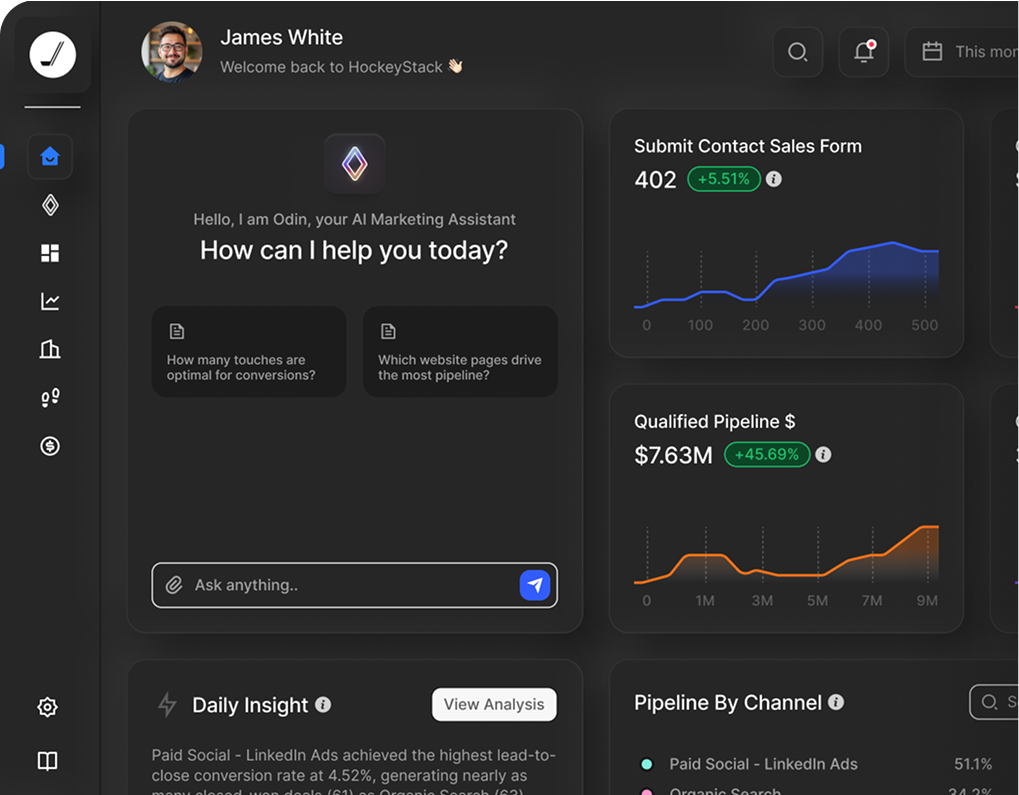
Ready to see HockeyStack in action?
HockeyStack turns all of your online and offline GTM data into visual buyer journeys and dashboards, AI-powered recommendations, and the industry’s best-performing account and lead scoring.
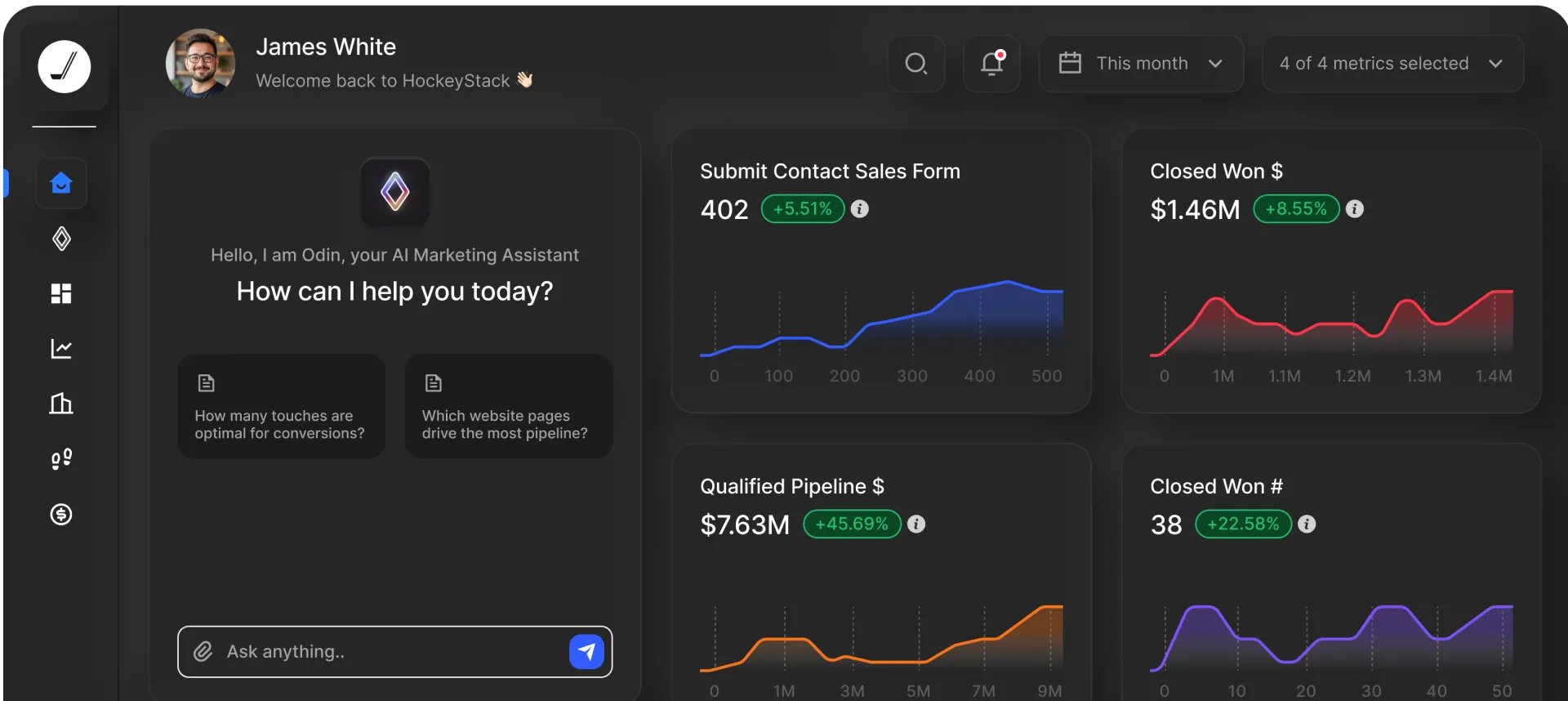
Ready to See HockeyStack in Action?
HockeyStack turns all of your online and offline GTM data into visual buyer journeys and dashboards, AI-powered recommendations, and the industry’s best-performing account and lead scoring.
