What Is A Revenue Agent?

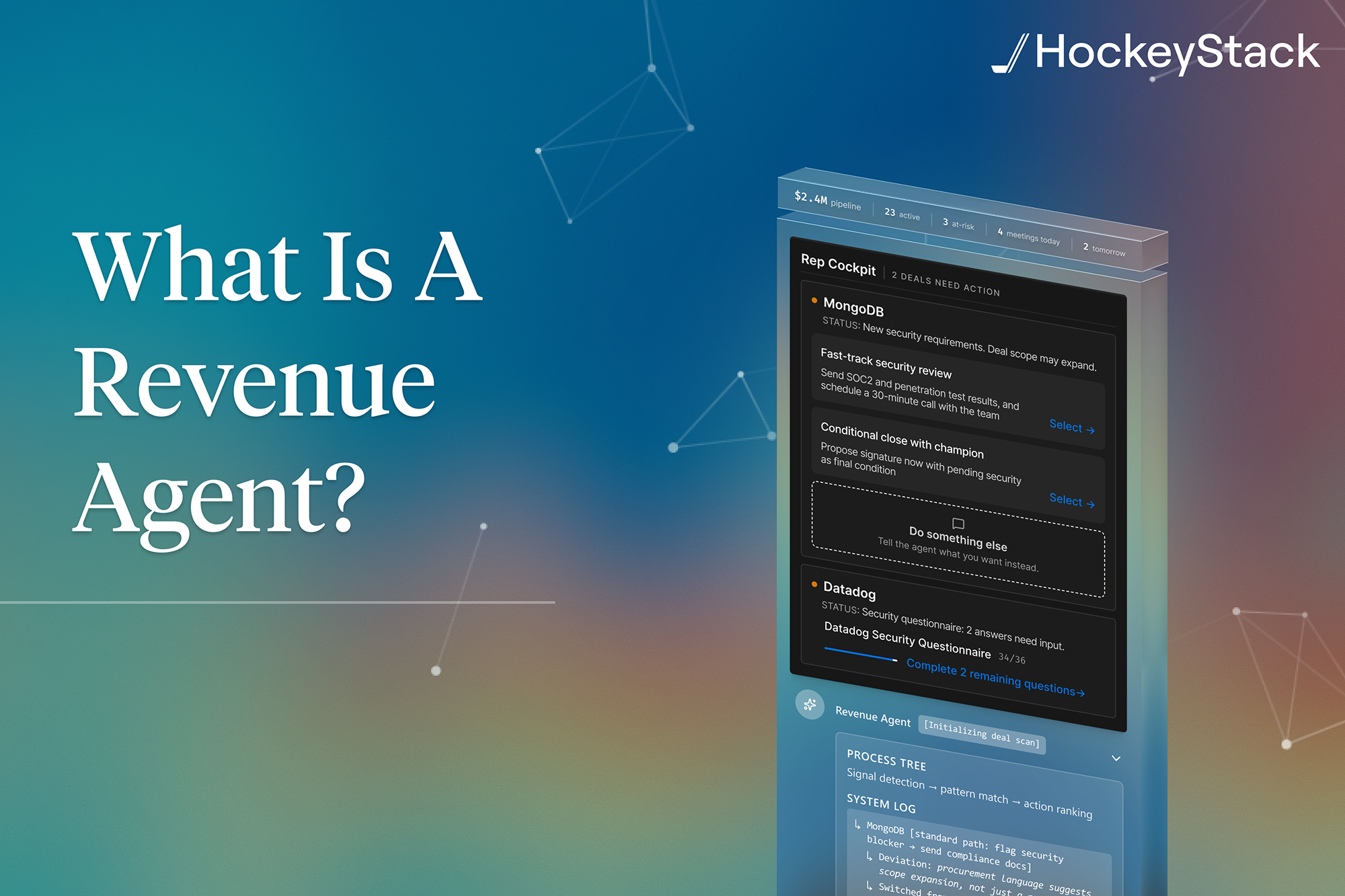
AI for revenue teams continues to fall short. It’s a well-funded, crowded market with a few exciting players, but no one company has truly come out ahead.
Research “agents”, analysis “agents”, and cold calling “agents” are everywhere. And, while there’s been some success, none of them have been transformative in how we work.
But what is an agent, really?
A true agent needs to be able to make decisions, run autonomously nonstop, and help you get your work done. As revenue teams make hundreds of decisions daily across multiple departments and volumes of data, Revenue Agents should be held to a higher bar.
It’s a bar that not one company has cleared. Yet.
The Revenue Agent Gap
Revenue Agent companies sit in one of three categories:
- Workflows: Set triggers, rules, destinations, and enrichment/routing.
- Co-pilots: A prompt interface to get an answer to a question.
- Task-specific AI: Getting one simple task done faster.
.jpg)
While these are undoubtedly helpful in the way that point solutions can be, what’s missing is these systems lack reason, decision, and autonomy.
Most importantly, they are not getting work done. More often, teams feel AI fatigue; overwhelmed by underperforming tools that promise to do it all.
Let's take the example of Nate, our founding AE at HockeyStack. In early 2024, Nate would copy and paste all his Salesforce notes and a call transcript into ChatGPT. He'd enter a prompt to get an account summary or a pre-meeting brief that he would then share with Emir, our CRO. Later that year, he began to use research prompts, which would occasionally surface a signal or help with pulling a LinkedIn profile. There was no reasoning behind what signals Nate should be looking for, whether the signals measurably changed deal outcomes. At no point was the LLM reasoning on top of the data and telling him what the best action should be.
This is the before picture.
Revenue Is Not a Task, It’s a Motion
It’s August 2025. Nate's taking the lead on a strategic, SDR-sourced enterprise deal. An Account Manager will own the opp post-close, and our VP of Sales, Miki, needs visibility into risk and forecast.
Nate's 2024 GPT can help him draft emails and summarize his calls, but they have no idea this deal is tracking the same pattern as one that went closed-lost six weeks ago. His GPT can't see across deals, across people, or across time. They see Nate's slice and nothing else.
The biggest miss from Revenue Agents is treating a GTM operator’s work as a “task.”
Running a deal, expanding a contract, or breaking into an account is made up of thousands of decisions and patterns that lead to a single winning outcome.These are interdependent processes formed by actions that require human judgement, monitoring, and progress.
Workflows, co-pilots, and task-specific AI systems rarely feel like they're actually lightening your load because they can't see the full picture. Revenue is generated through interdependent processes, and isolated tools can only ever address fragments of that system.
The complexity compounds when you add the human layer: cross-functional teams, multi-stakeholder accounts, and the nuanced communication dynamics between them. True autonomy requires understanding not just what each team or account needs, but how they relate to one another and acting across all of those layers simultaneously.
Anatomy of a Revenue Agent
Go-to-market AI does not live up to the hype because of its current architecture.
Every GTM platform sits on the same 20-year-old foundation of CRM objects and fields, static records that a human manually updates.
When an agent is added on top of this foundation, it has no record of what happened between stages, which actions advanced the deal, or which missteps stalled it.
Adding agentic intelligence to a system that was designed for manual data entry ends in AI fatigue and inefficiency.
A true Revenue Agent needs three data layers to execute effectively on behalf of revenue teams:
.png)
Layer 1: An Event-Based Data Foundation
Before building the agent, objects and fields need to be replaced with an “event chain” data model. Every action, interaction, and signal gets stitched into a linear timeline at the account, deal, and person level. This preserves the order, the timing, and the relationships between everything that happened.
When your data architecture captures causality instead of fragmented snapshots, you can start extracting the institutional, contextual knowledge in your data.
Layer 2: A Blueprint
A “blueprint” layer sits on top of the event chain and reverse-engineers the human judgment your best reps and managers have been making for years.
This is not a playbook someone wrote, and it's not an LLM summarizing your CRM. It's a machine learning model.
The difference matters: an LLM reads your data and generates a best guess every time you prompt it. The blueprint extracts measurable patterns from thousands of deals and validates them against your historical outcomes: which sequences of actions close deals faster, which behaviors stall them, what breaks a deal loose. Because it's built on structured features, it's deterministic: same data, same answer, every time.
As new deals close, the model retrains and the blueprint updates itself.
Layer 3: Compiled Agents
Most "agents" interpret a prompt at runtime and the quality relies on the prompt. The agent also lacks the human judgment and business context buried in your data.
Compiled agents work differently. The institutional knowledge is encoded and understood before the agent takes action. It doesn’t need a prompt. Instead it knows what your best reps do to close deals, it extracted the information from behavioral patterns across thousands of deals.
Every deal gets its own Revenue Agent anchored to carrying the blueprint data, reasoning, and context. That institutional knowledge is compiled into the agent before it ever runs.
HockeyStack in Action: Revenue Agents for the Enterprise
This is the architecture behind HockeyStack's Revenue Agents. Here's how it works on Nate's enterprise deal.
Data Foundation: Our CRM says Nate’s deal is in Stage 3 (Demo) with the last activity logged 4 days ago. Our data foundation, Atlas, captures what our CRM doesn't: every touchpoint across the deal stitched into a single timeline. The unlogged pricing page visit, the 11-day gap between Introduction and Demo, and the email that was never replied to.
Blueprint: HockeyStack’s Blueprint has been trained on hundreds of Nate’s deals and identifies that deals matching this profile (enterprise segment, multi-product, single-threaded to a director) close at a 3.2x higher rate when multi-threaded with a VP of RevOps. The Blueprint also flags that this deal is tracking the same pattern as one that went closed-lost six weeks ago.
Revenue Agent: The agent surfaces two options to Nate: ask your existing champion for an intro to the VP of RevOps, or draft cold outreach directly. It knows that the right move depends on the strength of the relationship, and that's a judgment call only Nate can make. It prepares both paths with messaging that has historically worked for this persona at this deal stage. Nate picks one.
If he takes no action in 48 hours, the agent flags Miki with the deal risk, the data behind it, and the recommended action.
No human asked the agent to do this.
No one prompted it, and no one set up an automation.
The agent diagnosed the situation, reasoned through the data, surfaced a judgment call for the right person at the right time, and did it autonomously.
At every other company, Nate had to learn the tribal knowledge from scratch, operationalize it, wait for feedback, and learn from the data on his own.
With HockeyStack, agents are always on. And, Nate does what he’s the best at: Building relationships and closing deals.
.png)


%20(1).png)