The Deal Agent: Your Best Closer on Every Deal


The Deal Agent: Your Best Closer on Every Deal
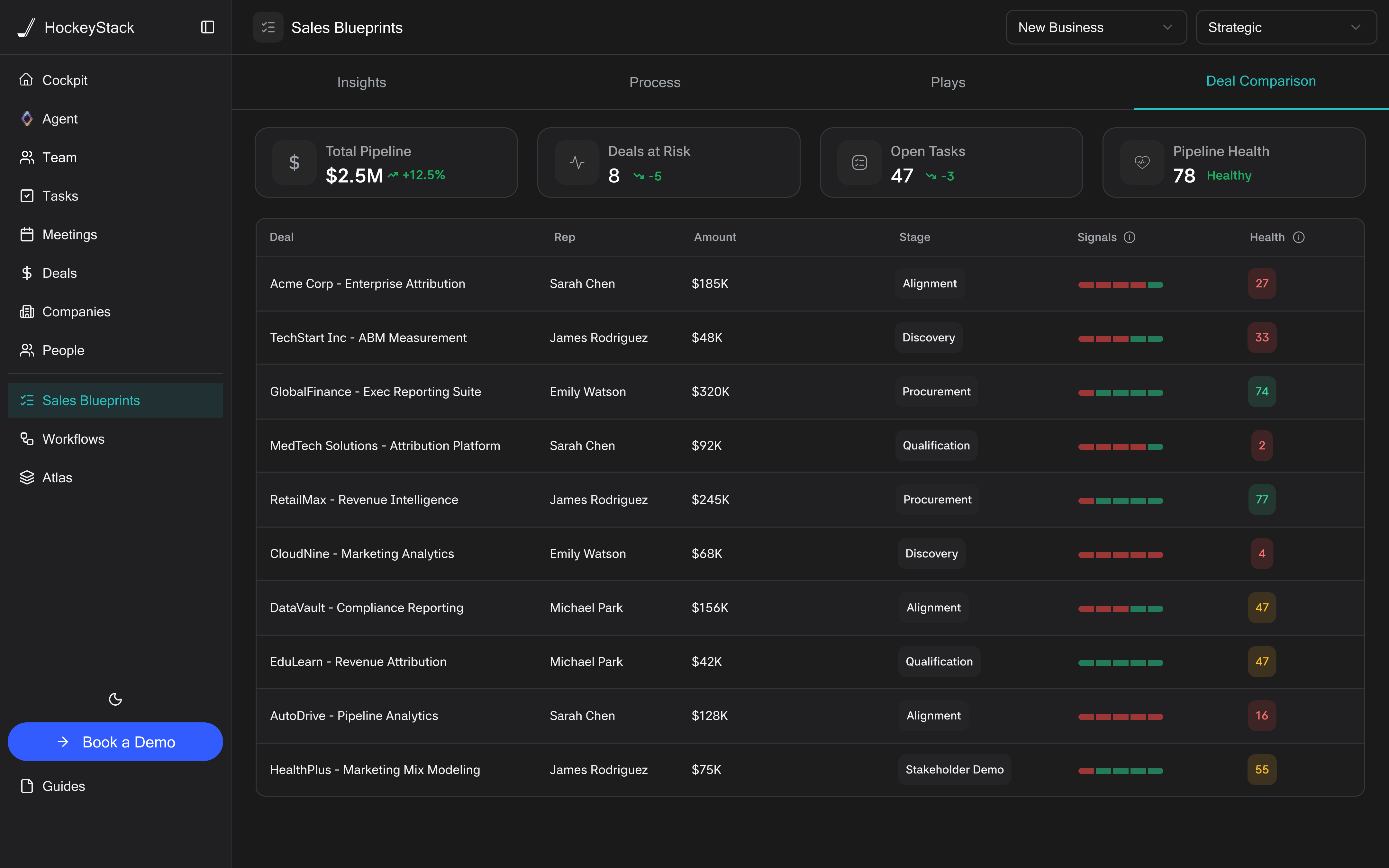
One dedicated agent per deal, working the way your top reps do.
Every revenue org has a small group of reps who close at rates the rest of the team can't replicate. They multi-thread instinctively. They send the recap before it's asked for. They know which dormant relationship to reactivate when a deal stalls. Their behavior is the difference between a 60% win rate and a 25% one.
Their instincts have historically been impossible to scale. It lives in the heads of two or three people, surfaces in moments that are hard to teach, and disappears the moment those reps get promoted or leave.
The Deal Agent is how HockeyStack scales winning instinct.
Every open opportunity gets assigned a dedicated agent. Its job is to run that deal the way your best closer would, using the patterns the Blueprint has extracted from your historical data. It monitors the account, identifies risk, drafts outreach, surfaces the next best action, and works the deal continuously until it closes.
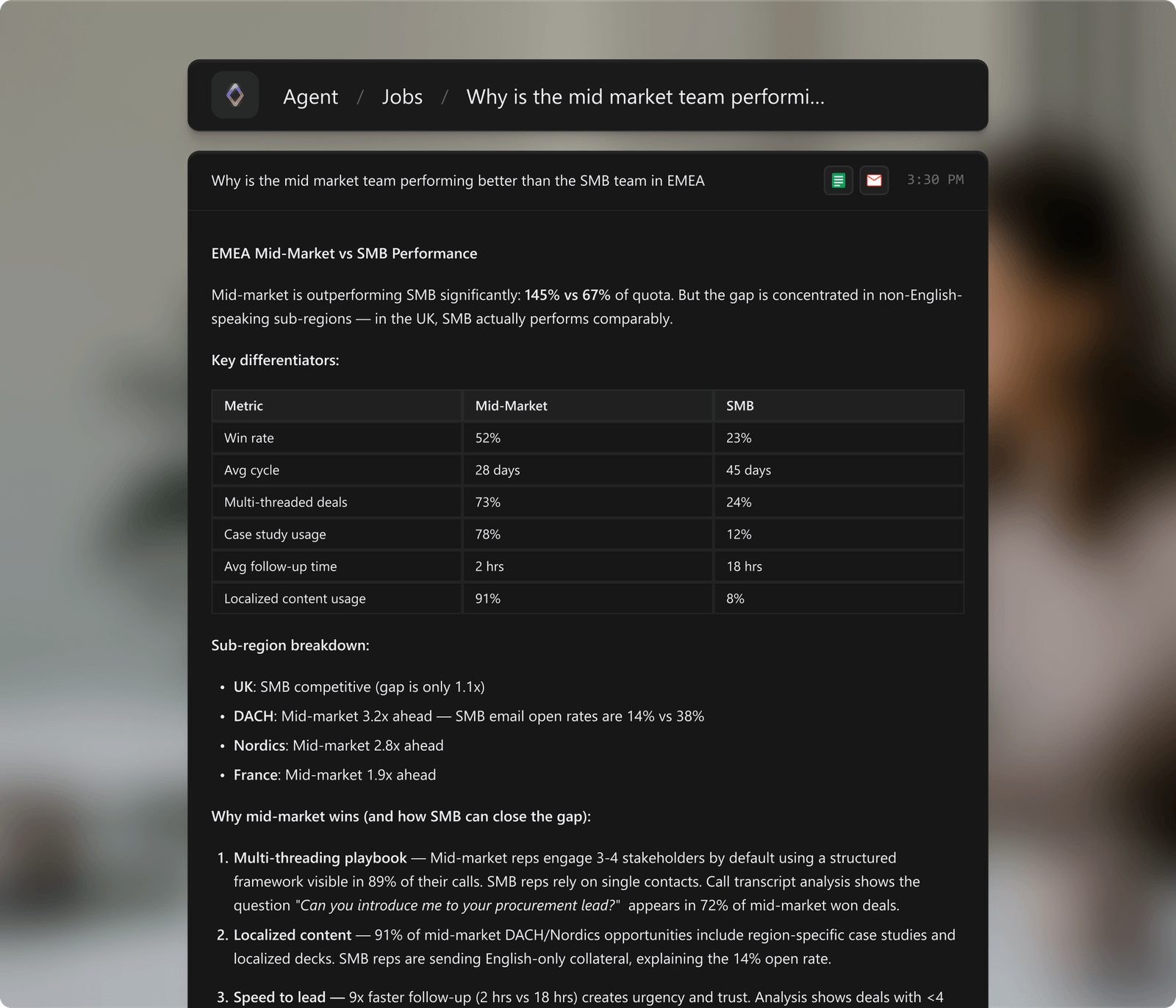
The Deal Agent Core Promise
Imagine your strongest closer, and imagine their entire job was working a single deal. Not their territory, not their pipeline, just one deal.
That rep would watch every call recording. They would read every email in the thread. They would know every stakeholder by name, role, and relationship. They would follow the winning pattern for that deal profile without having to think about it.
The Deal Agent does it for every open opportunity. One agent per deal. All the time.
What it does
Monitors the deal continuously
The Deal Agent carries the full account history, every call transcript, every email, every product usage signal, every interaction tied to the buying group, and every third-party signal HockeyStack ingests on the account.
It also updates in real time. The call you're on right now feeds into the agent's context the moment the transcript is processed.
Surfaces the next best action
The Deal Agent inherits the relevant Blueprint for the deal's motion, segment, and product line. It updates stakeholder maps proactively, surfaces multi-threading plays and gives proactive suggestions. When the deal needs an action, the Deal Agent generates a task. Each task includes:
- The reasoning. Why this action, why now, what in the deal triggered it
- The drafted artifact. Email, LinkedIn message, call script, deal-room send, multi-thread outreach, in the rep's voice and using the highest-converting historical phrasing for that scenario
- The supporting evidence. Which past deals this pattern came from, what lift it produced
When the deal deviates from the winning path, the Deal Agent runs the recovery move that brought similar deals back. When a stakeholder goes silent, it flags it before the rep notices. When the timing of a proposal or a deal room is what closes the gap, it surfaces the urgency and the artifact together.
Answers questions and executes in the rep’s behalf
Every deal has a chat surface where reps can ask the Deal Agent anything and the agent can take autonomous action on the rep’s behalf. The agent has the full context of the deal and the Blueprint behind it. Common questions reps ask:
- Why did this similar account go closed-lost last year, and what should we do differently?
- Who else at this company should we be multi-threading with, and why?
- What objections have we run into with this buyer profile before?
The agent reasons against your data, not against a generic LLM context window. The answer is grounded in your closed-won and closed-lost deals. Once the agent makes a suggestion, its capable of executing independently on behalf of the rep.
Two things this changes
Compresses ramp time
A new rep traditionally needs three to six months to start performing. Most of that time is spent absorbing tribal knowledge: shadowing senior reps, sitting in on calls, asking the same questions about which stakeholder to engage and when, learning the company's particular rhythm of closing.
The Deal Agent puts that knowledge in front of every new rep on day one. They open their task list and see what their best closer would do, with the reasoning and the draft already written. They don't need six months of pattern-matching to figure out the company's winning move on a stalled deal in mid-market. The agent already knows.
Closes the attainment gap
The bell curve is the shape of every revenue team. A few reps consistently hit above 100%, a middle pack lands at 60 to 80%, and the tail sits below 50%. The variance is rarely about effort. It is about which actions reps take and when.
The Deal Agent narrows the spread. The middle pack starts running the same plays the top performers run, on the same cadence, with the same precision. The bottom of the bell curve rely on their Blueprint-grounded path through every deal instead of guessing. Win rate moves up across the team because the variance moves down.
Variance reduction like this has historically been impossible to engineer through enablement alone. Documentation, training, playbooks, and shadowing all chip at it. None of them solve it, because the moment a rep is alone with a deal, the playbook is in a tab they don't open. The Deal Agent puts the playbook in the workflow.
Two examples from our internal instance
Reactivating a dormant relationship under a new product
Jeremy Levine, one of our investors at Bessemer Venture Partners, introduced HockeyStack to a target account in early 2024 for our marketing platform. The conversation went a few rounds, the timing wasn't right, and the deal closed-lost.
When Revenue Agents launched a year later, the Deal Agent surfaced a task: ask Jeremy for a fresh introduction, this time to the sales side of the org, under the new motion. It pulled the original intro thread, drafted the reactivation email referencing the prior context, and prioritized the task based on the account's current fit.
The rep wouldn't have remembered that thread without digging through closed-lost emails from the year before. The Deal Agent surfaced it with the draft already written.
.png)
Catching the warm path through a former champion
A closed-lost opportunity from two years prior had a strong relationship with a buyer who has since moved to a new company. That new company is now in the rep's prospecting list as a cold account.
The Deal Agent identified the connection: the original champion is at the new account, the rep on that historical deal had a personal relationship with him, and the team's VP of Sales also knows him from a previous job. The drafted outreach leads with the VP connection, references the prior working relationship, and surfaces the opening that exists at the new company.
This is the kind of detail no rep would assemble manually. It would require reading every email in a closed-lost deal from two years ago, cross-referencing current LinkedIn data, and finding the second-degree connection through a teammate's history. The Deal Agent does it as a default behavior.
What managers see
Every deal has a health score that reflects how closely it's tracking the Blueprint's winning path. Risk signals surface per deal: silent champion, no pre-call fit-check, no exec engagement before stage three, missing multi-threading. The signals are tied to historical data, not heuristics.
Managers can also ask the Deal Agent questions about specific deals directly. What's the biggest risk in this opportunity? Why is the health score dropping? What would my best rep do here? The agent answers against the same context the rep is working from, which means coaching conversations start with shared diagnosis instead of with the manager re-internalizing where the deal is.
Pipeline reviews shift. Instead of walking through every deal in detail, managers focus on the deals the Deal Agent has flagged and the reps whose Blueprint compliance is slipping. Coaching becomes evidence-based: here is the pattern your top reps run at this stage, here is where you're skipping it, here is the lift if you don't.
Conclusion
The Deal Agent is what happens when the Blueprint moves from a model into execution. The patterns that drive your top closers' results stop living in their heads and start running against every deal in your pipeline.
A new rep gets the company's winning playbook on day one. The middle of the bell curve starts executing like the top. The risk signals that used to surface in the deal review now surface the moment they appear. And every deal that closes or stalls feeds back into the Blueprint, which feeds back into the agent, which sharpens with every cycle.
Your best rep is one person. The Deal Agent is your best rep on every deal.
How does HockeyStack track users?
HockeyStack’s automatic tracking is not magic, although it certainly feels like that. In this article, you can learn how we track users without using cookies while being GDPR compliant.


Ready to see HockeyStack in action?
HockeyStack turns all of your online and offline GTM data into visual buyer journeys and dashboards, AI-powered recommendations, and the industry’s best-performing account and lead scoring.
Ready to See HockeyStack in Action?
HockeyStack turns all of your online and offline GTM data into visual buyer journeys and dashboards, AI-powered recommendations, and the industry’s best-performing account and lead scoring.
