The Definitive Guide to Buying AI for B2B Revenue Teams


AI adoption alone has not been enough to move the needle for revenue teams. All AI tools are not built equal, and getting results requires choosing the right ones.
Most revenue teams have already invested heavily in AI: 80% of revenue teams are using three or more AI tools. And yet revenue leaders regularly report increased complexity and workload after adopting AI tools, with an average satisfaction score of 3.9 out of 7. And through it all, the most fundamental problems have not moved at all: 62% of leaders still name pipeline as the root cause of missed quarter, the same answer they’ve been giving for a decade.
To avoid this trap, here’s what you should consider when buying AI for revenue teams.
Data Completeness
Consider a rep who has been working a deal single-threaded to a VP of Sales for six weeks. She has no idea that two other people from that account have been independently visiting the product pages, one of whom went to college with her CFO. A buying committee is forming without her knowing it and the perfect warm introduction is completely invisible. Her AI tool, which reasons over CRM data and call transcripts, is just as blind. The gaps are significant: anonymous web activity, ad engagement, email threads, historical interactions from closed-lost accounts, personal connections, and more.
The right data foundation ingests every signal across the GTM stack and stores it as a time-ordered chain of events. It captures activity far before a lead enters your CRM, resolves every interaction to a single identity, and preserves the order of events. That complete record is how the system can determine the sequences of events that lead to wins, which signals predict churn, and which interactions actually matter. Every output is informed by the full picture, not just whatever made it into the CRM.
Before you buy, ask:
- Does your data foundation capture activity before a lead enters the CRM?
- Can it tell me not just what happened, but in what order?
- Does it handle deduplication and identity resolution automatically?
- Will it work with my existing categorizations?
Determinism
Take three reps working nearly identical deals at the same stage with the same segment. An AI tool gives each one a different recommendation for next steps, with no evidence or reasoning to examine. The result is inconsistent execution across similar deal, outcomes that vary for no clear reason, and a pipeline review where the numbers are hard to explain and harder to learn from.
This happens because most AI tools are probabilistic, which meant they can produce a different output even if given the same data and the same prompt. They rely solely on LLMs and produce outputs based on runtime interpretation of context. Determinism, on the other hand, produces the same output for the same inputs every time.
The ideal system is a deterministic model built on machine learning. The winning process is encoded in structured features and validated against historical outcomes, instead of relying on runtime prompt interpretation. If a rep is told to loop in a VP of Finance by day 10 on a mid-market multi-product deal, that recommendation traces back to a specific pattern in your data: deals with this profile, at this stage, with this stakeholder configuration, closed at a 3.2x higher rate.
Before you buy, ask:
- Is your system deterministic, or does it rely solely on LLMs?
- Can you show me the reasoning behind a specific output?
- Will running the same deal through your system twice, with no changes to the underlying data, lead to the same output?
User Experience
Most AI tools increase rep workload before they reduce it. A VP of Revenue Operations paid for an AI tool for six months before noticing her team had quietly stopped logging into it. Reps had to move context from the AI tool into the CRM, cross-reference call recordings in another place, open their email in a separate tab to send out follow-ups.
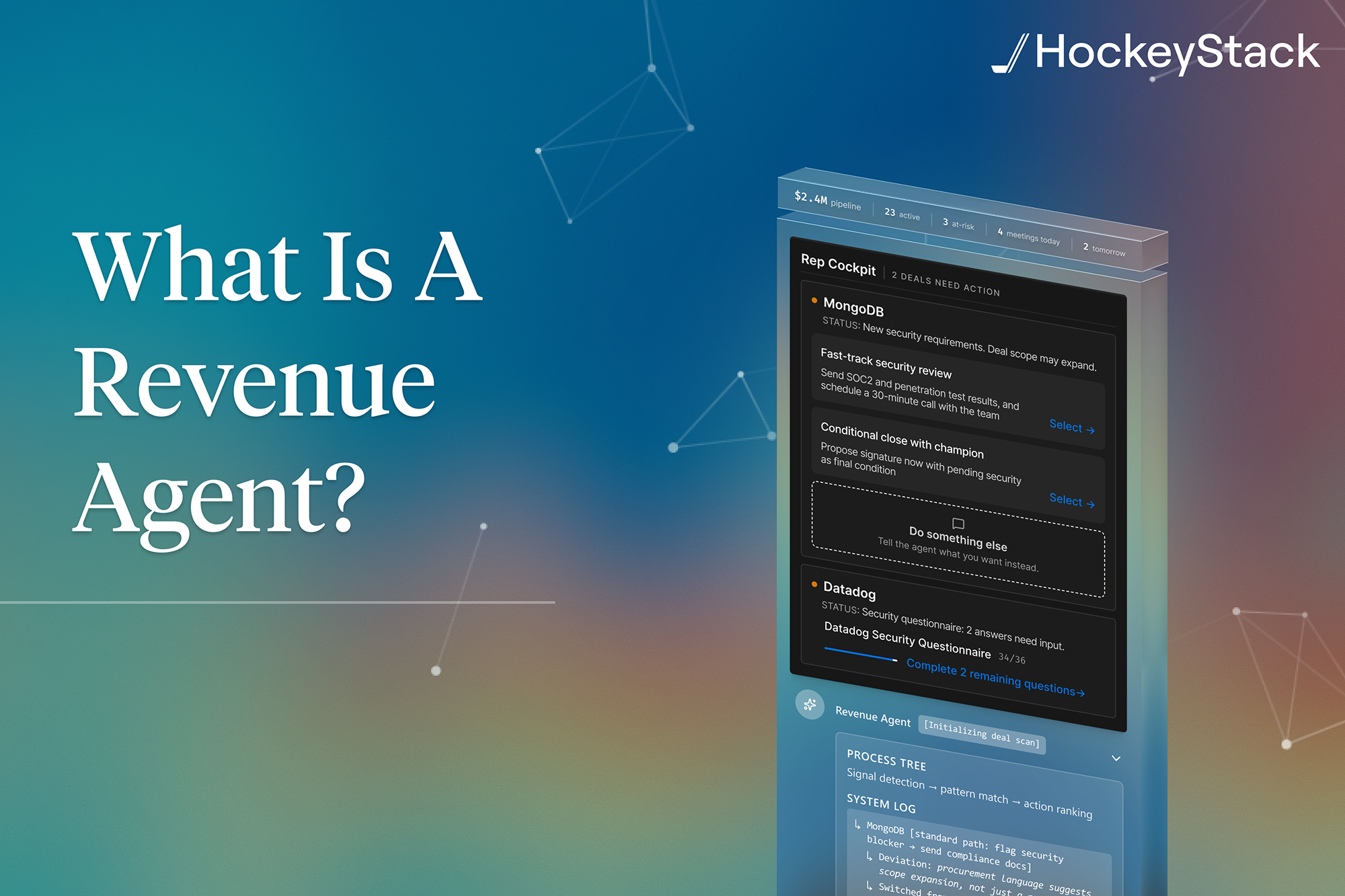
The right system fits smoothly into your reps’ existing workflow with a Salesforce iframe. It removes work by providing a prioritized task list, full context on each account, and outreach that is pre-drafted and ready for one-click approval. With no new interface to learn and no change to existing habits, onboarding is fast and adoption follows naturally. Managers get a clear view of which deals are deviating from the winning pattern without a dedicated pipeline review, enabling targeted, timely, data-driven coaching.
Before you buy, ask:
- Can reps interact with your system through a Salesforce iframe?
- Do tasks come with context about each deal?
- Can reps chat with the agent to refine tasks?
- How can managers use your interface to track deal health and pipeline?
Self-Improvement
Most AI tools do not update once you deploy them. If your best reps change what they do or your ICP evolves, the model has no way of knowing. A rep dismisses the same AI recommendation every time it surfaces a particular type of outreach. She is right to. That approach stopped working six months ago when the market shifted. But the one-year-old system does not know that. It keeps generating the same recommendation for every rep on the team because nothing the reps do in the field feeds back into the model. A static system decays over time and steadily becomes less accurate. What starts as a slight drift becomes a significant gap. By the time reps notice the recommendations are unreliable and abandon the system altogether, months of pipeline have already been worked with stale guidance.
The optimal system treats every outcome as a data point. Every completed task, every dismissal, and every closed-won and closed-lost deal automatically feeds back into the model and makes it better. The longer it operates, the more precisely it reflects how your organization wins. And when your process changes, the model shifts with it.
Before you buy, ask:
- Does your system improve over time?
- Is improvement automatic from rep actions and deal outcomes, or does it require manual configuration?
Inverted Model
Most AI tools surface insights, generate suggestions, or flag risks. The burden of decision-making and execution still falls on the rep. The system simply assists.
The best systems flip that dynamic. Agents take autonomous action across every deal and every account, and pull reps in for the moments that actually require a human: judgment calls, relationship moves, and conversations. The rep is no longer a gatekeeper or operator, and can focus on what they do best.
Before you buy, ask:
- Does your system execute work autonomously, or does it generate generic next steps that reps have to manually execute?
- What happens on a deal when the rep is not actively working it?
- How much of the work gets done without rep input?
Conclusion
When running an enterprise revenue organization, choosing the right AI tools is critical. While the wrong choice leads to wasted money and increased complexity, making the right choice means value compounds across every part of the operation:
- Rep variability goes down because every rep is executing the same proven winning process instead of relying on instinct and guesswork.
- Ramp time compresses because new hires inherit the tribal knowledge of your top performers on day one.
- Pipeline becomes more predictable because the system flags drift before is becomes a missed quarter.
The key criteria to consider when buying AI tools for revenue teams:
- Data Completeness: Does your data foundation capture activity before a lead enters the CRM? Can it tell me not just what happened, but in what order? Does it handle deduplication and identity resolution automatically? Will it work with my existing categorizations?
- Determinism: Is your system deterministic, or does it rely solely on LLMs? Can you show me the reasoning behind a specific output? Will running the same deal through your system twice, with no changes to the underlying data, lead to the same output?
- User Experience: Can reps interact with your system through a Salesforce iframe? Do tasks come with context about each deal? Can reps chat with the agent to refine tasks? How can managers use your interface to track deal health and pipeline?
- Self-Improvement: Does your system improve over time? Is improvement automatic from rep actions and deal outcomes, or does it require manual configuration?
- Inverted Model: Does your system execute work autonomously, or does it generate generic next steps that reps have to manually execute? What happens on a deal when the rep is not actively working it? How much of the work gets done without rep input?
HockeyStack was built to address each of these concerns:
The organizations that pull ahead will not be the ones who bought the most AI tools. They will be the ones who bought the right ones.
Stop investing in the wrong AI tools, and start driving pipeline with HockeyStack.
.png)


%20(1).png)