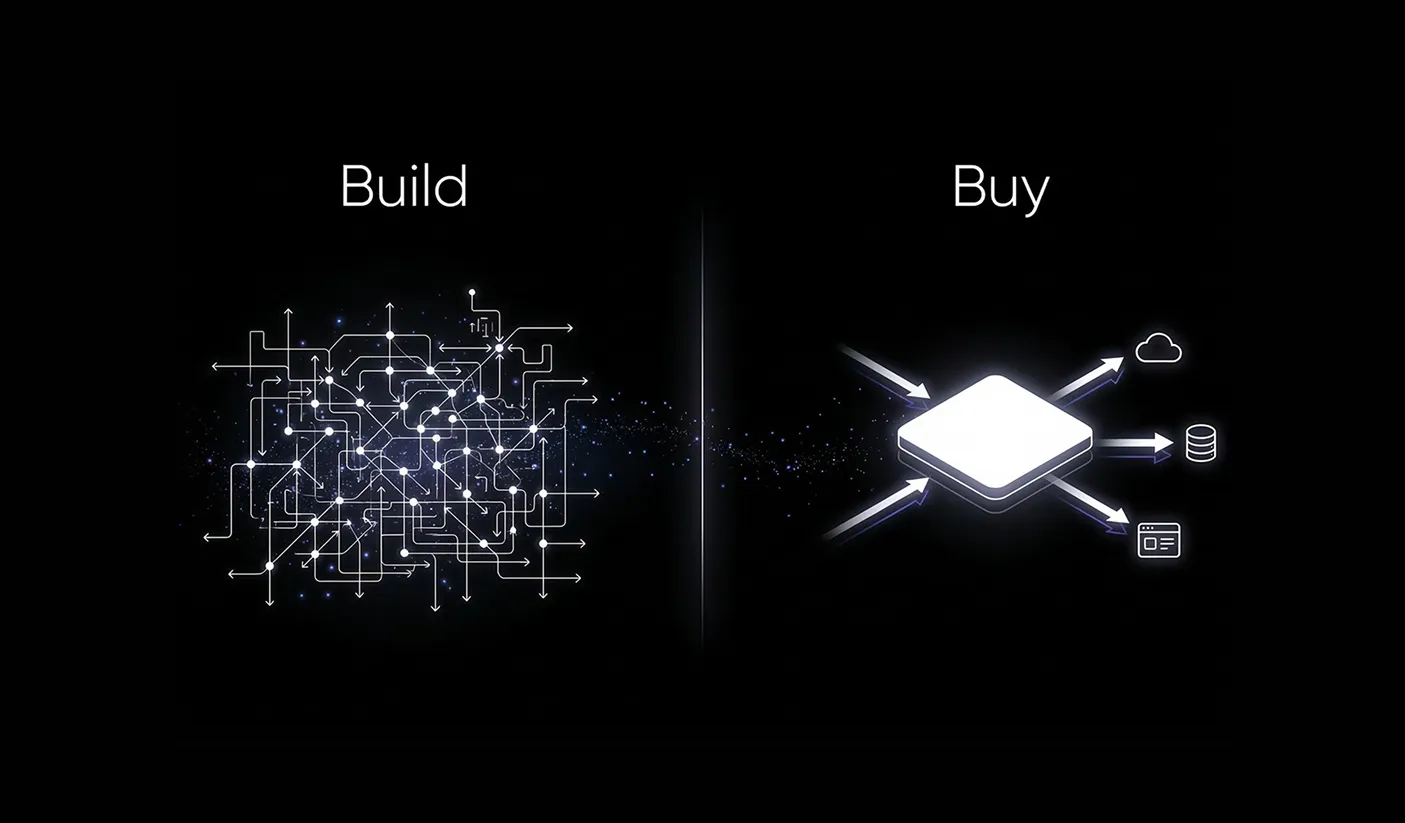
Why a GTM-Native Workflow Language Beats General-Purpose AI for Revenue

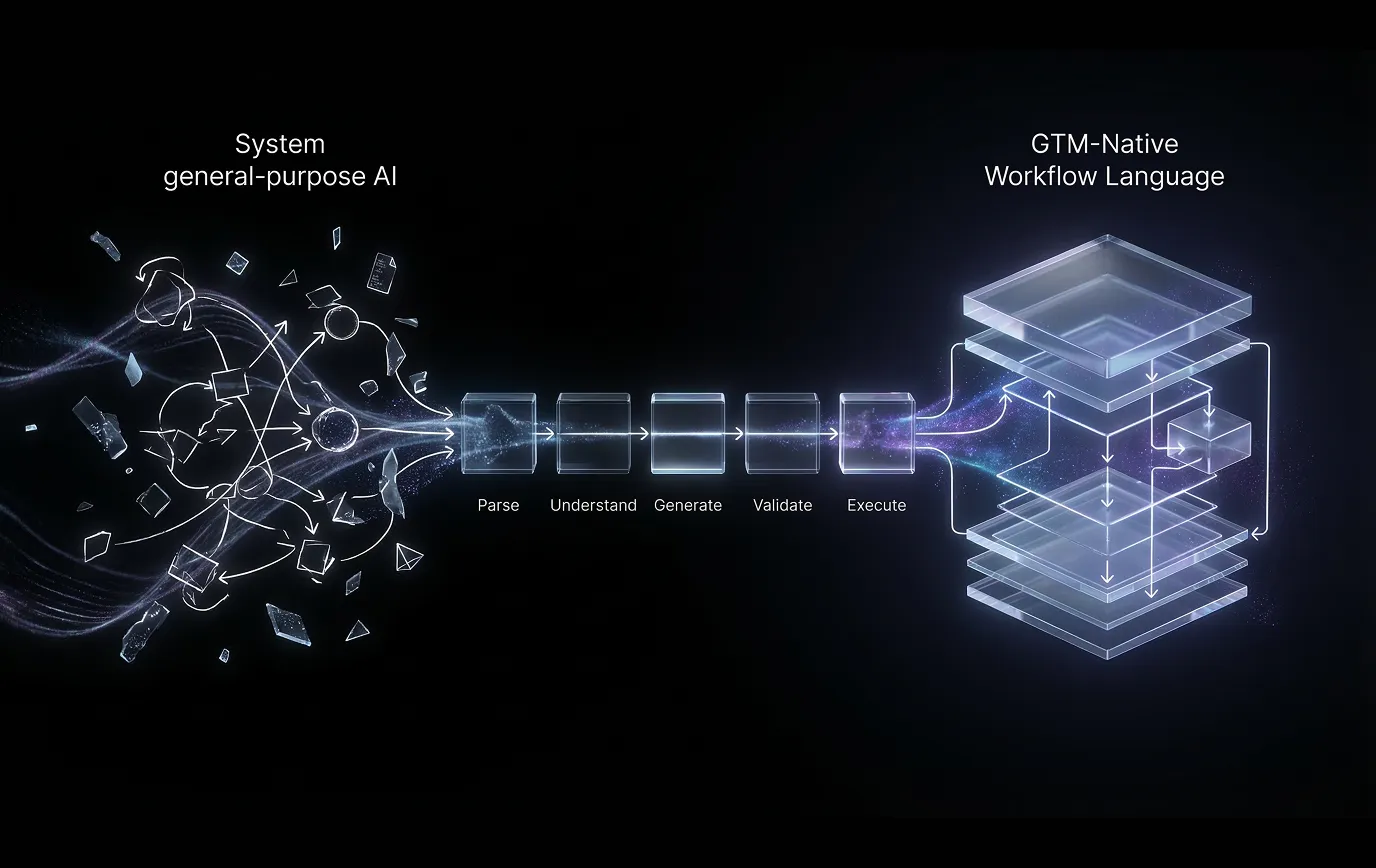
Compilation solves the prompting problem. But what you compile into matters as much as whether you compile at all.
In one line: A generic workflow with GTM logic buried in prompts and configuration is better than no workflow. A workflow language built natively for deals, contacts, events, and rep actions is better still. The domain knowledge lives in the language, not in what you've glued around it.
Compilation is the right foundation. When you translate your instructions into a fixed workflow at build time rather than re-interpreting them on every run, you get consistency, auditability, and something you can version and roll back. That much is settled.
But compilation leaves a question open: what language is the workflow written in?
A generic orchestration tool gives you a compiled workflow. The steps are defined. The sequence is fixed. It runs the same way every time. What it doesn't give you is a shared understanding of what a deal is.
The Vocabulary Problem
To build a deal validation workflow in a generic tool, you'd define what a deal is in your configuration, point a step at your CRM to fetch one, pass the result to the next step, and so on. The orchestration handles the sequencing. Everything specific to your domain lives in the configuration and prompts you've written around the generic steps: what a deal is, how to get the contacts on it, where to find the related Gong calls, what a "stage" means.
This works. But it means every workflow you build re-implements the same domain knowledge from scratch. There's no shared vocabulary across your processes. Each one re-specifies how to fetch deals, how to traverse to contacts, what fields to look at. Validation tells you whether the steps ran, not whether the right GTM operations ran.
The deeper problem: even though the workflow is compiled, the domain is still in the prompt. You've moved the execution structure to build time. The GTM semantics stayed behind.
What a GTM-Native Workflow Language Does
HockeyStack's workflow language is built around the objects that revenue processes actually operate on. The data model has companies, deals, the contacts on a given deal, meetings, calls, emails, and sales activities. Relationships between them are defined in the language itself. A deal belongs to a company. A deal has contacts. A meeting links to a company and a deal. These aren't things you configure per workflow. They're the vocabulary of the language.
The available operations follow from that data model. Workflows don't call generic API steps. They call:
- Filter and retrieve deals by stage, close date, amount, or engagement level
- Traverse from a deal to its company, contacts, and related events
- Pull call recordings and Gong summaries for a deal
- Create rep tasks, sync updates to the CRM, synthesize signals into a report
"Validate deal stage from calls and meetings" or "build a revival report for closed-lost deals with recent engagement" are natural shapes in this language, not things you construct from generic parts. The steps are the domain.
This changes what compilation produces. When you write instructions in plain language and HockeyStack compiles them, the output isn't "call LLM, then call API, then call API again." It's "fetch deals matching these filters, get company and events per deal, synthesize, create task." Deals, contacts, events, and rep actions are the primitives: the basic building blocks the language operates on. There's no GTM logic buried in prompts wrapped around generic nodes.
Why This Matters in Practice
Consistency across processes. Every HockeyStack workflow uses the same data model and the same operations. "Get contacts on this deal" means the same thing in your stage validation workflow, your meeting prep workflow, and your revival report. In a generic tool, each workflow re-specifies how to get there.
Validation that means something. When a workflow compiles, it's checked against the GTM data model and the available operations. Not just whether the syntax is valid, but whether the workflow is using the right objects and relationships. A workflow that tries to traverse a relationship that doesn't exist won't pass.
Reuse without re-implementing. Because the domain is in the language, patterns are reusable across agents. The "fetch deals, get company and events, synthesize" shape works for stage validation, deal reviews, pipeline hygiene, and meeting prep, without re-encoding what a deal or a company is each time.
How It Works
You write your instructions in plain language. HockeyStack's compilation pipeline translates them into a workflow using the GTM-native operations described above. The output is validated against the data model before anything runs. Only workflows that pass that check get saved and executed.
At runtime, the engine runs that workflow as defined. It's not re-interpreting your instructions. It's executing the compiled sequence of GTM operations on whatever records you're processing.
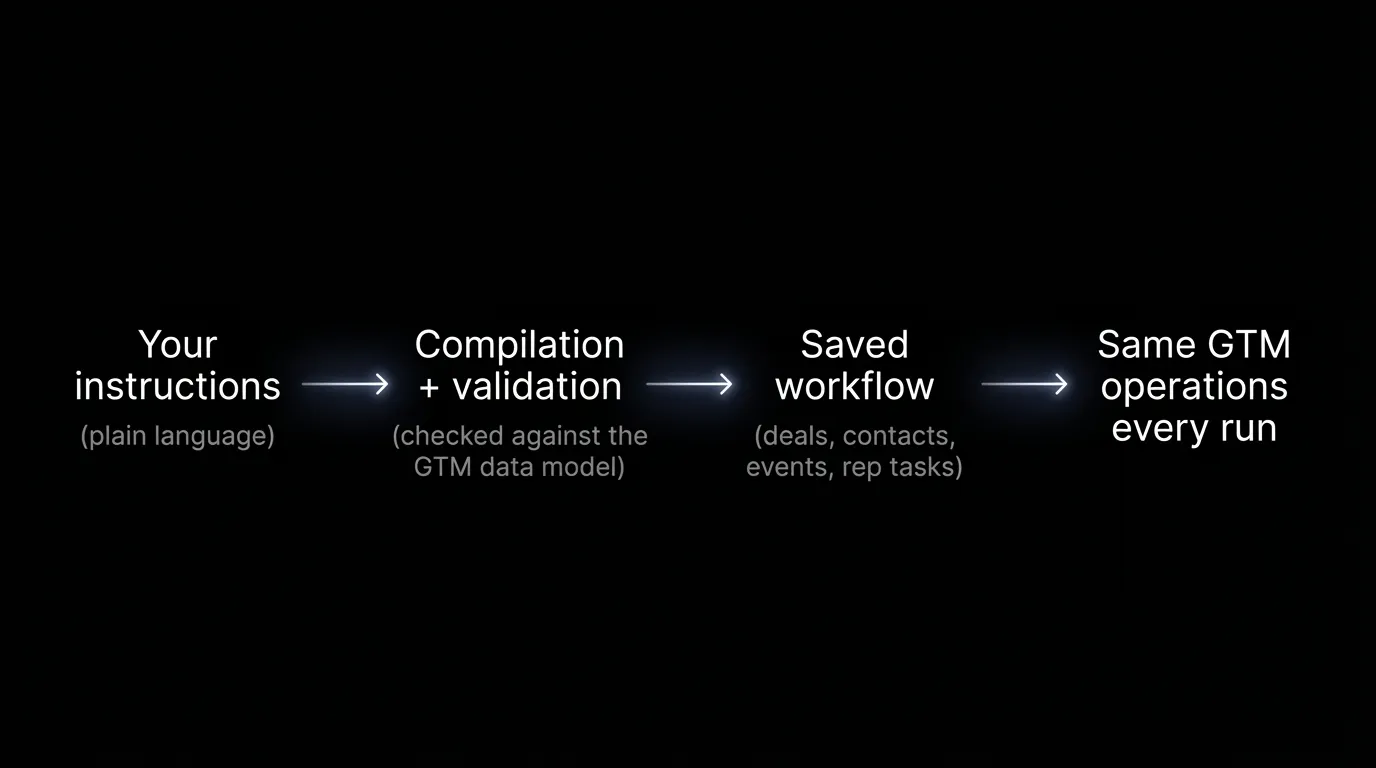
The model helps at compile time, translating your intent into the workflow language. At runtime, it contributes reasoning inside individual steps: summarizing a Gong call, synthesizing signals into a recommendation. The shape of the process is fixed. The vocabulary it operates in is GTM.
The 10,000-Deal-Cycle Analogy
A smart generalist can read your playbook and follow it. Someone who's run 10,000 deal cycles doesn't need the playbook written down. They know what a stuck deal looks like, what it means when a champion goes dark, which activity patterns tend to precede a close. That knowledge is internalized. It's part of how they think, not something they look up each time.
A GTM-native workflow language works the same way. The knowledge isn't in the prompt. It's in the language itself: what a deal is, what it's connected to, what operations make sense on it. Compilation gets you consistency. The right language gets you a system that already speaks GTM.
For more on the compilation vs. prompting foundation, see Why Enterprise AI Needs More Than Prompting.