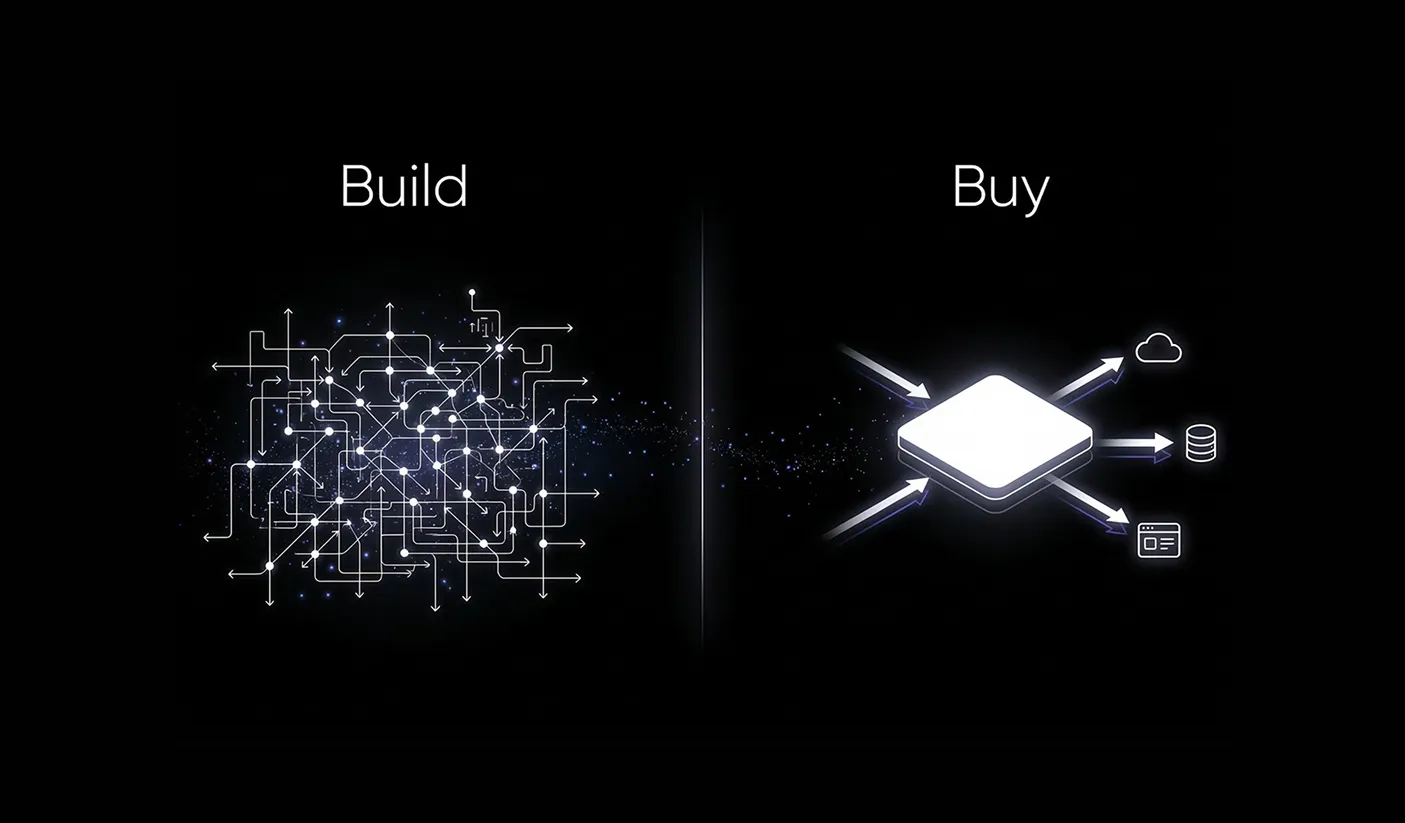
Why Revenue AI Fails When You Skip a Layer


Revenue AI that actually changes rep behavior requires three things: a unified data model, a winning pattern, and executing agents that feed outcomes back to the model for continuous learning.
In one line: Other approaches treat data, intelligence, or execution as optional. We treat all three as non-negotiable so the system can discover the optimal process and execute it consistently.
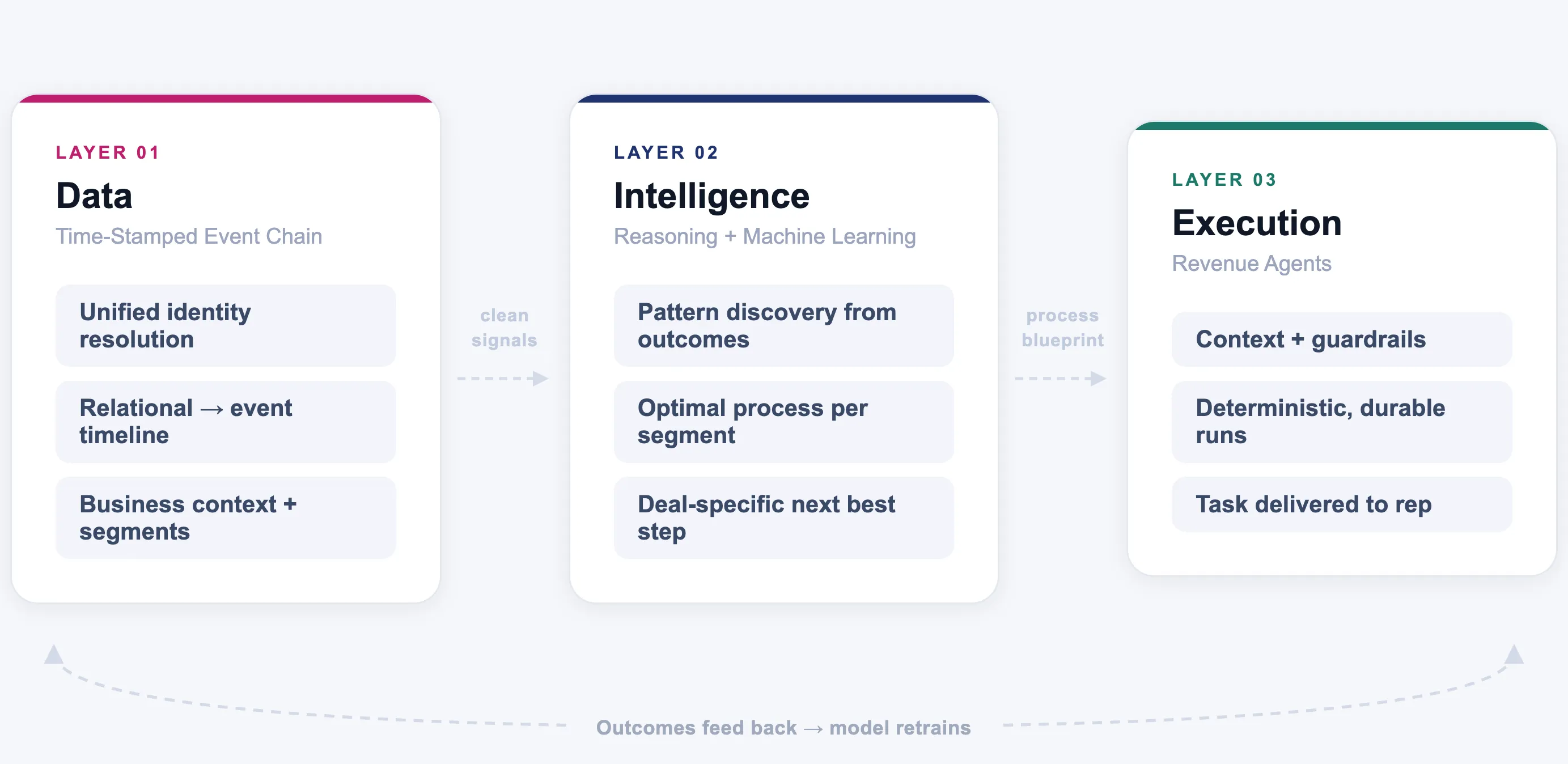
The three layers (and why they're all required)
Any system that aims to optimize the sales process and execute it consistently has to do three jobs.
Data. Ingest, clean, and unify everything that describes customer-seller interactions so the next layer sees one coherent picture instead of fragmented records.
Intelligence. Discover what actually leads to wins and losses, derive the optimal process from outcomes, and produce deal-specific and deterministic next steps.
Execution. Turn those next steps into tasks that reach reps, with guardrails and feedback so completion and outcomes flow back and the system improves.
Why the data layer is non-negotiable
Without a real data layer, revenue AI reasons over noise. Same person in five places, same meeting in two systems and the related deal in another with no link. The model is asked to infer "what's the right next step?" from a fractured view of reality. It will hallucinate sequence or give a recommendation based on the wrong deal state. No amount of better prompting fixes that.
The data layer's job is to resolve and unify identities before any intelligence or execution runs. "This contact" and "this lead" need to be one person. "This call" needs to be tied to "this opportunity" without the agent having to guess. We categorize with business context so pattern discovery runs on the reality of your go-to-market, not a mess of disconnected records.
The shape of the data matters as much as its completeness. Revenue questions are about order: first touch, last touch, full story before the call, why did this deal stall? Most systems store data as a graph of related things and treat ordering as an afterthought, sorting by date at every step. When there’s no sequence, seeing cause and effect is very difficult. The alternative is a data model built as an event timeline: what happened, when, for which deal. That's the bar for pattern discovery and next-best action that rely on real sequence instead of guessing it.
An event-based data model is where any of this starts.
Why the intelligence layer is non-negotiable
Even with perfect data, you still need to answer: what process actually wins, and what should this deal do next? Two legacy approaches fail consistently:
Manager-defined process. A leader watches some calls and writes a playbook. Reps are supposed to learn it and follow it. No manager can articulate the full decision tree of a winning deal; that knowledge is more instinctive than anything. Manual compliance checking doesn't scale, execution drifts and the playbook takes its rightful place on the shelf.
CRM-centric process. The natural instinct is to design the workflow around pipeline stages and fields. The problem is that CRM stages are leaky. They don't map to what's actually happening in the deal. You're optimizing for stage progression in the system, not for the behaviors that move deals towards closed-won.
The intelligence layer exists to discover process from outcomes. Analyze historical wins and losses: what fit, what behavior, and in what context. We can derive the optimal process, not document what a manager thinks should happen. We’ll map the current deal state to that pattern and output the next step.
Without this layer, you have human intuition (doesn't scale) or CRM ritual which rarely reflects reality. You don't have a discovered, data-driven process built from wins.
Why the execution layer is non-negotiable
The final failure mode: you have good data and you've discovered the right next step, but nothing changes rep behavior. Execution is where "best next step" becomes something the rep actually does, the same way, every single time.
Execution has to do four things.
Deliver in context. Right place at the right time.
Be concrete. Who to contact, what to say, when, what kind of action (call, email, etc.).
Be deterministic run over run. The agent produces a structured workflow so it does the same thing every run for the same situation. Consistency at scale is the point.
Enforce guardrails. The agent separates internal reads (tools) from external writes (actions), so every outbound touch has channel limits, send caps, and approvals before it fires.
Close the loop. Reps complete or dismiss tasks (and say why); completion and outcomes flow back so the system learns what works. Managers get insights into process drift (how far off are we from the ideal path) and forecast accuracy signals.
Deployment speed is the payoff: the traditional path (QBR to RevOps to training to cascade to measurement) takes a quarter or more. With a real execution layer, define the agent and guardrails and tasks go to reps in weeks. Same scale for 1,000 or 100,000 reps.
Execution turns "we know the next step" into "reps do the next step" and "the system gets smarter."
What happens when you skip a layer
The system works when all three layers connect: unified data feeds pattern discovery, pattern discovery feeds execution, and execution feeds results back into the model. That's when every rep gets the best next step on every deal, and the system gets smarter with every outcome.
This is how revenue AI actually changes how teams operate: a closed loop from data to process to action to learning.
Questions or a technical deep-dive for your stack? Contact your HockeyStack team.