Everything You Need to Know About AI Agents for GTM Teams in 2026 [+Top 10 Solutions]


Everything You Need to Know About AI Agents for GTM Teams in 2026 [+Top 10 Solutions]

Summary:
- The market is saturated with AI-driven tools but not all solutions provide equal value. AI copilots, AI SDRs, and other types of automation platforms may be inefficient for GTM teams looking to effectively optimize long, complex buyer’s journeys.
- GTM AI agents differ from other types of automation tools by their ability to autonomously execute multi-step workflows and make contextual decisions in response to real-time buyer behavior and account activity.
- True GTM AI agents also use integrated GTM data to capture touchpoints across campaigns and channels, analyze engagement patterns, and surface dynamic causational insights into pipeline performance.
- The most critical criteria to evaluate for GTM AI agents include data Integration and identity resolution capabilities, real-time data processing and query performance, accuracy/explainability and hallucination prevention measures, and flexibility for business-defined logic.
- Best practices for integrating AI agents into your GTM stack: Determine your integration requirements, define the key GTM questions you want to answer, pick 1-2 use cases to guide vendor evaluations, consider future scalability requirements, and ensure you have onboarding support and change management resources in place for successful adoption.
More than half of GTM leaders see either no impact or limited impact from AI. Part of the issue is the staggering influx of AI-driven solutions on the market—there were 15,384 MarTech solutions on the market in 2025 and 77% of new products added in the past year were AI-native.
GTM AI agents—enabling revenue engines to essentially self-improve their own pipeline in real-time—now coexist alongside ad hoc automation tools that do little more than add bloat to your tech stack, instead of helping you determine what’s actually driving revenue.
And that’s just the thing: not all AI is created equal. It can be difficult to tell the difference, especially when every vendor under the sun now describes their solution as AI. That’s where this trusty guide comes in. You’ll learn:
- How GTM AI agents differ from copilots and other automation tools
- 5 major benefits of GTM AI agents + specific use cases to consider for sales, marketing, and RevOps teams
- How to effectively evaluate AI agents for your GTM stack
- Warning signs for AI agent washing
- 10 GTM AI agents to consider
Let’s get started!
What Are AI Agents for GTM Teams
AI agents use real-time GTM data to provide dynamic insights into campaign and channel performance, personalize sales and marketing messages at scale, and automate repetitive tasks, enabling GTM teams to operate more efficiently and effectively.
What sets AI agents apart from traditional automation? It all boils down to action. While “AI-powered” features may suggest next steps or surface insights for humans to act on, AI agents continuously monitor your GTM data and independently execute multi-step workflows—from prospecting and enriching data to sending outreach and analyzing attribution—instead of waiting for someone to click a button.
True GTM AI agents have four primary characteristics:
- Autonomous execution: Completes multi-step workflows on their own
- Data unification: Integrates with full range of GTM data sources, including CRM, marketing automation platform (MAP), ad platforms, web analytics, and sales engagement tools
- Real-time decision-making: Adapts to live signals and buying behavior rather than static rules
- Learning capability: Improves recommendations based on outcomes over time
GTM AI Agents vs Copilots and Automation Tools
But not every “AI-driven” solution delivers equal value to GTM teams—especially if you’re grappling with lengthy, non-linear buyer’s journeys and several channels (read: data sources) to optimize. Knowing the major differences between GTM AI agents and other types of sales and marketing automation tools will help you evaluate more effectively.
AI Copilots
AI copilots assist GTM teams by providing suggestions, generating content, and surfacing information in response to general queries. However, copilots are reactive by design and will wait for you to ask for assistance.
AI SDRs and Outbound Automation Tools
AI SDRs and other outbound automation tools streamline specific GTM motions like email sequences and scheduling meetings. While teams gain efficiency by offloading more cumbersome tasks, workflows are typically optimized independently of the broader buyer’s journey.
Autonomous GTM AI Agents
GTM AI agents offer chat-based recommendations of copilots and workflow automation capabilities of AI SDRs. But they also go a lot further by:
- Analyzing expansive touchpoints throughout the buyer’s journey
- Evaluating pipeline performance across campaigns and channels
- Executing actions in response to real-time buyer behavior, rather than fixed rules or manual prompts.
Agents facilitate a total shift from reactive insights to autonomous, real-time GTM intelligence.
5 Benefits of AI Agents for GTM Teams
GTM teams generally see the most value when they treat agents like interconnected components of a centralized revenue intelligence system, rather than isolated point solutions or ad hoc workflow automations. The benefits of this approach include:
1. Complete Visibility At Every Stage of the Buyer’s Journey
CRM data fails to capture pre-conversion and anonymous engagement that often constitutes the bulk of buyer activity. According to Forrester, 90% of the buyer’s journey is complete before a prospect reaches out to sales.
GTM AI agents can fill in the gaps with identity resolution, which unifies anonymous web activity, ad engagement, sales touches, and post-conversion behavior into a single view— effectively connecting fragmented data points to individual accounts and stakeholders. The result is a more complete picture of how accounts actually move through your funnel.
Pro-Tip: AI agents handling sensitive GTM data should use data isolation, encryption, access controls, and audit trails to ensure data security and compliance standards are met. Whatever you do, make sure AI agents don't use customer data to train global models.
2. Real-Time GTM Intelligence
True GTM AI agents process data in real-time, eliminating the delay between buyer engagement and insight. This helps enhance routing, attribution, and decision-making, which erode when their underlying data is stale.
3. Accurate Multi-Touch Attribution and Causal Insights
It’s not exactly a secret that B2B buyer’s journeys are complex. According to Gartner, the average enterprise buying group now consists of 5-11 stakeholders. Our own research found it now takes an average of 266 touchpoints to close a B2B opportunity—a 20% increase since 2023.
Even GTM teams with mature B2B multi-touch attribution models can struggle to effectively distinguish which touchpoints lead to conversion and which ones merely correlate with it. GTM AI agents provide deeper attribution insights and causal evidence for budget allocation by measuring lift, incremental impact, and channel influence—so you can determine which activities are actually driving pipeline.
4. Faster Decision-Making
Since agents are connected to every GTM data source, teams can quickly get the pulse on different segments, channels, campaigns, geos, and products—without having to submit tickets or wrangle dashboards in SQL. Siloed data and bottlenecks turn into easy and actionable insights that everyone can use on a regular basis, especially with GTM AI agents that can answer complex questions in everyday language.
Pro-Tip: Ensure your GTM AI agents can provide underlying data and methodology behind their recommendations. Every insight an AI agent surfaces should be traceable back to its source data. Explainability is critical—a good rule of thumb is if you can't see how the agent reached a conclusion, you can't trust it for high-stakes decisions.
5. Lower Costs and Maintenance-Free Scaling
GTM teams are often painfully aware that homegrown attribution and analytics solutions come with hidden costs: constant integration maintenance, campaign tagging updates, and high dependency on engineers who understand how everything connects—like a select group of field scientists maintaining a delicate ecosystem.Agents reduce the burden of maintaining internal data pipelines, schema updates, and attribution logic.
GTM AI Agent Use Cases for Sales, Marketing, and RevOps
Agents dramatically improve efficiency, visibility, and insights across every GTM function, but they also offer specific benefits to sales, marketing, and RevOps teams.
GTM AI Agents for Sales Teams
GTM AI agents can surface buyer intent signals and recommend next best actions on active deals, as well as suggest re-engagement tactics for stalled opportunities based on what’s previously worked.
They also enrich leads with account-level engagement data before outreach—like what content was previously consumed, which stakeholders are currently engaged, and where the deal might be stuck—so reps don’t go into a call blind.
GTM AI Agents for Marketing Teams
Marketing teams use GTM AI agents to analyze which campaigns, assets, and channels actually drive pipeline—not just clicks or impressions. GTM AI agents can also identify underinvested channels relative to their ROI and flag underperforming content before it drags down campaign performance.
GTM AI Agents for RevOps and Enablement Teams
RevOps teams can leverage GTM AI agents to centralize reporting across sales, marketing, and customer success. When everyone works from the same data, alignment improves exponentially.
GTM AI agents can also apply governance, establishing common definitions for touchpoints and funnel stages to enable more consistent performance analysis and measurement.
How to Evaluate AI Agents for Your GTM Stack
AI agents are constantly growing and evolving. In fact, the capabilities of Language Learning Models (LLMs) are doubling approximately every seven months. So how do you determine the best choice for your GTM stack? Consider the following criteria:
Data Integration and Identity Resolution Capabilities
GTM AI agents are only as good as the data underneath them. To effectively enhance visibility and pipeline performance, agents should ingest data from the following sources:
- Your CRM
- Marketing automation platform (MAP)
- Ad platform
- Web analytics
- Product telemetry
- Cloud warehouses
Pro-Tip: Look for GTM AI agents that handle duplicates, anonymous engagement, and enterprise account hierarchies automatically. If you have to clean your data before the agent can use it, you'll spend more time on preparation than on insights.
Real-Time Data Processing and Query Performance
Latency doesn’t just break GTM automation, it compromises accuracy—especially since agents are designed to work autonomously. Look for GTM AI agents that can process data in real-time. With the right infrastructure, even expansive datasets with billions of rows can deliver sub-second query latency.
Alternatively, batch processing—which updates overnight—means your routing, attribution, and recommendations are always a day behind.
Accuracy, Explainability, and Hallucination Prevention
AI outputs require validation against source data before reaching users. The best GTM AI agents use deterministic analysis for metrics and trends rather than relying solely on LLM reasoning, which can hallucinate numbers that look plausible but aren't real. Every recommendation should be traceable and auditable—if an agent tells you to shift budget to a particular channel, you want to see the data that supports that recommendation.
Flexibility for Business-Defined Logic
Any AI agent that locks you into predefined logic will become a constraint rather than an accelerator as GTM strategies evolve. Your team—not the vendor—should be able to define funnel stages, channel groupings, attribution rules, and ICP segments.
How to Spot AI Agent Washing
Agent-washing happens when vendors label basic automation or copilots as “AI agents”. Some of the more common red flags to watch for:
- Requires manual data stitching before use
- Cannot operate without constant human prompts
- Limited to single-channel or single-system data
- Outputs aren't explainable or traceable
If the tool can't tell you how it reached a conclusion, it's probably not a true AI agent.
10 Best AI GTM Agents to Accelerate Pipeline Growth
Now that you know what makes a good AI agent for GTM, let’s take a look at the top solutions on the market.
HockeyStack
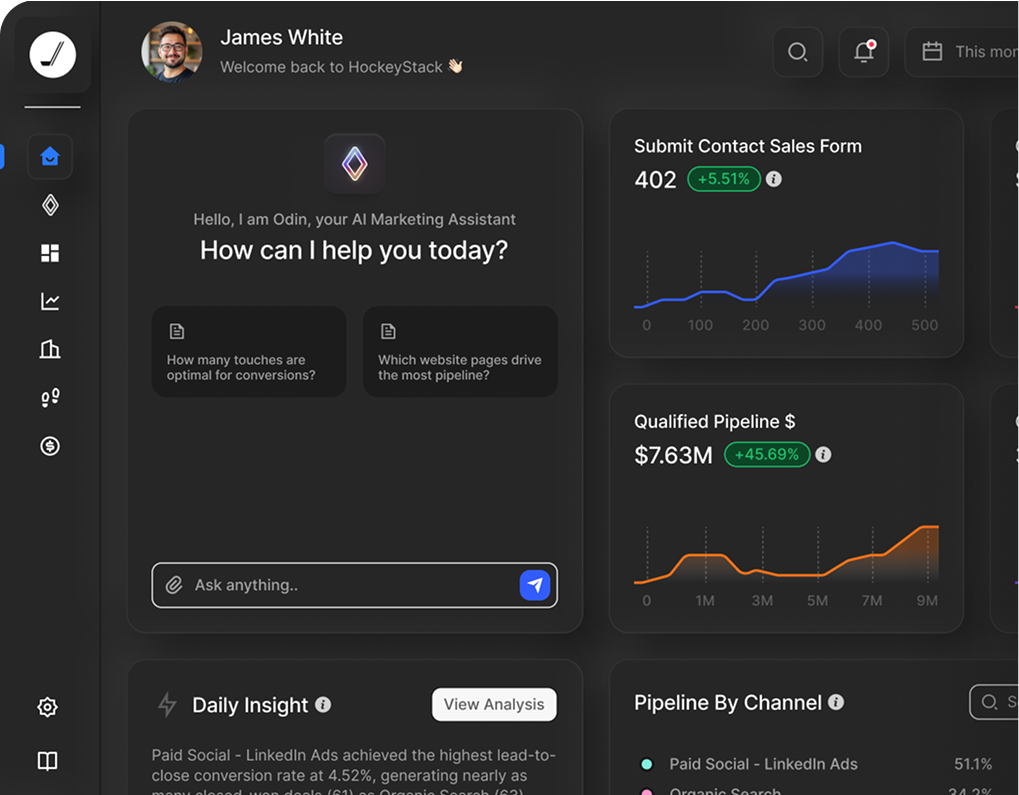
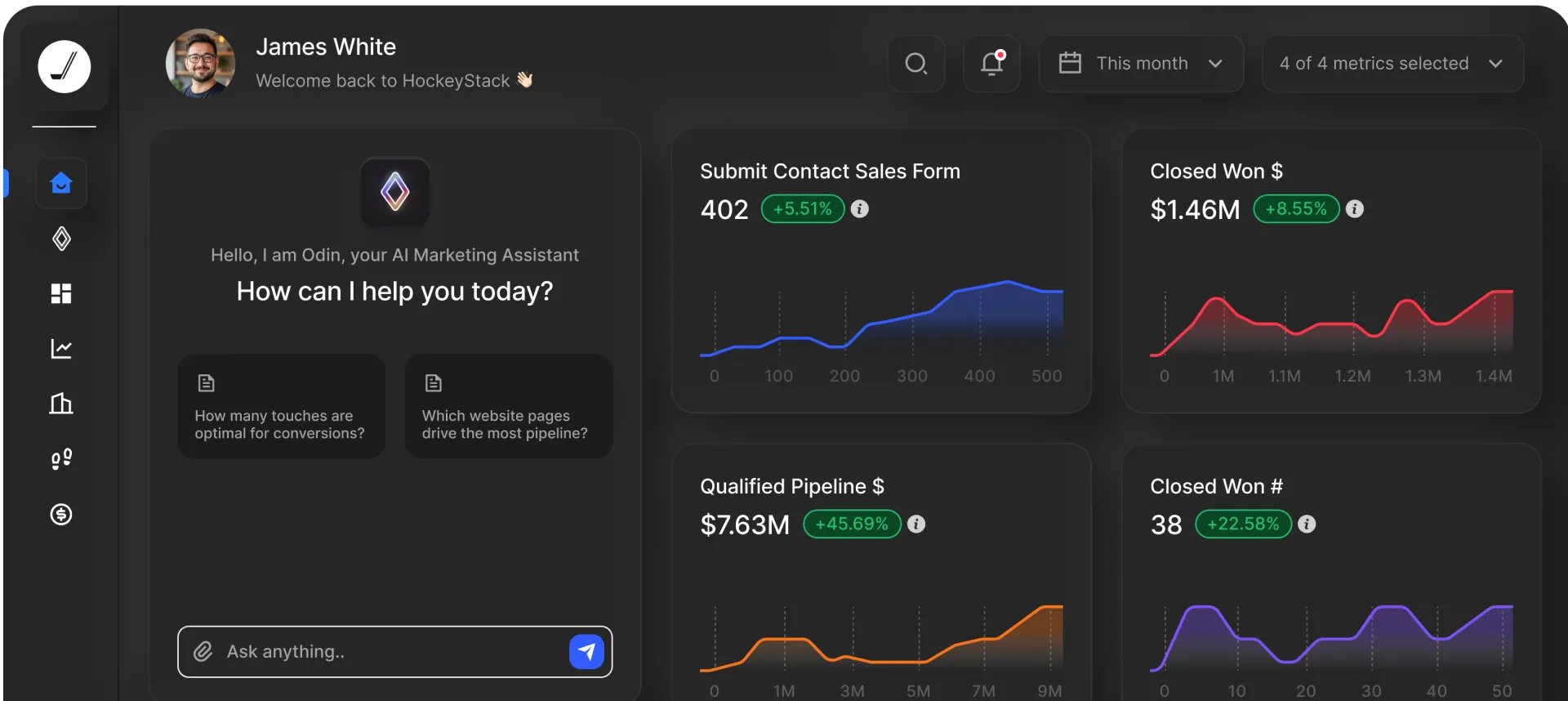
HockeyStack is a GTM AI platform purpose-built for complex B2B buyer’s journeys. Agents operate off a core, unified GTM data foundation—spanning every campaign, channel, and touchpoint—bolstered by real-time processing and proprietary fingerprinting technology to capture anonymized engagement.
HockeyStack offers two analyst agents, Odin for marketers and Nova for sales teams. Odin provides next-step recommendations to improve pipeline performance and instant answers to nuanced marketing questions—like “Which Q3 email campaigns influenced the most enterprise pipeline?"—all in plain English. Nova provides real-time, chat-based account intelligence directly in Salesforce.
Additionally, HockeyStack comes fully loaded with a diverse range of pre-built agentic GTM workflows, including:
- Multi-touch attribution anomaly detection
- Next best step generation for open deals
- Expansion opportunity location
- Closed-lost deal resurrection
- Weekly rep coaching
HockeyStack uses multi-agent orchestration—one agent retrieves data, another runs the analysis, and a third validates the output before you see it. This ensures unparalleled data quality, with every output traceable to its original source.
11x.ai Alice
Alice is an autonomous AI SDR agent designed for outbound prospecting and inbound qualification.
Key features
Alice handles autonomous prospecting by researching and targeting accounts based on pre-defined criteria. It also identifies and engages prospects with personalized and contextual outreach messages across email and other channels.
Benefits
Teams can scale outbound capacity without adding headcount—Alice maintains consistent follow-up execution, so no prospect falls through the cracks.
Artisan Ava
Ava is a virtual AI sales agent that specializes in outbound personalization at scale. The agent handles the full outbound workflow from research to send.
Key features
Ava automates prospect research, gathering context on leads before any outreach occurs. The agent then deploys sequences tailored for each prospect, autonomously managing end-to-end execution.
Benefits
SDR teams save significant time on manual research and personalization. Outreach reflects genuine prospect context, improving the message quality over generic templates.
Clay AI Research Agent
Clay's AI Research Agent focuses on data enrichment and building targeted prospect lists. The agent pulls data from multiple sources to create comprehensive lead profiles.
Key features
AI-powered research extracts specific information based on customizable criteria, while workflows connect to outreach tools for a seamless handoff. Custom data points can also be configured to accommodate unique research requirements.
Benefits
Clay supports custom research workflows that adapt to specific targeting requirements, offering teams more flexibility and comprehensive prospect intelligence.
People.ai
People.ai automatically captures sales activity data—including emails, meetings, and calls—without manual entry.
Key features
Automatic activity capture eliminates the burden of manual CRM data entry. Opportunity insights surface deal health and engagement patterns, while coaching recommendations help identify rep behaviors tied to successful outcomes.
Benefits
Sales leaders gain more visibility into execution quality across the team. Its activity data also enhances coaching and reporting.
6sense Revenue AI
6sense is a predictive intelligence platform that identifies in-market accounts using intent signals, which indicate if a company is
actively researching topics related to your product.
Key features
Intent signal detection identifies buying behavior before prospects raise their hands. Predictive scoring ranks accounts by likelihood to buy, and account-based orchestration coordinates outreach across marketing and sales.
Benefits
Intent data helps prioritize accounts showing buying signals, so GTM teams can focus their resources on accounts most likely to convert rather than spreading efforts evenly across the entire addressable market.
Salesforce Agentforce
Agentforce brings AI agents directly into the Salesforce CRM ecosystem with pre-built workflows covering sales, service, and marketing use cases.
Key features
Native CRM integration means agents work where sales teams already spend most of their time. GTM teams can use templates or customizable automation tailored to specific business processes.
Benefits
Enterprise security and governance come built in, which simplifies procurement and compliance reviews.
Clari Copilot
Clari Copilot focuses on revenue intelligence, providing a real-time view of deal progression across the entire pipeline.
Key features
Pipeline analytics show where deals stand at any moment. Forecast intelligence surfaces risks and opportunities, and conversation insights analyze sales calls for coaching opportunities.
Benefits
Forecast accuracy improves because risks surface early. Sales leaders can intervene on at-risk deals before they slip rather than discovering problems at the end of the quarter.
Unify
Unify is an intent-driven AI agent platform that coordinates outbound based on buyer signals. Outreach activates when prospects show intent rather than following arbitrary time-based cadences.
Key features
Signal-based triggers ensure outreach happens at the right moment. Multi-source data integration combines intent, enrichment, and engagement data, and automated sequencing executes personalized workflows.
Benefits
Signal-based outreach improves timing and relevance. Prospects receive messages when they're actively researching, which typically leads to higher response rates.
Apollo.io AI
Apollo.io combines a large B2B contact database with AI-enhanced prospecting and engagement features. The platform offers prospecting data and outreach execution in one place.
Key features
Contact database access provides a broad pool of B2B contacts and companies. AI-assisted prospecting recommends target accounts and contacts, and sequence automation handles email and calling workflows.
Benefits
Teams that want both data and execution in a single platform find value in Apollo's integrated approach. There's no need to export data to a separate outreach tool.
Build a Smarter GTM Motion with AI Agents
AI agents enable a shift from reactive reporting to proactive, data-driven GTM execution. HockeyStack offers end-to-end agentic workflows specifically designed for GTM teams, replacing disconnected tools and cumbersome dashboards with unparalleled visibility and actionable intelligence. Book a demo to see HockeyStack’s GTM AI agents in action.
FAQs About AI GTM Agents
What is the difference between AI agents and AI-powered features?
AI agents operate autonomously to complete multi-step tasks without human intervention. AI-powered features assist users with specific actions like writing suggestions or data lookups but still require human execution to move forward.
How do AI GTM agents handle data from multiple systems?
AI GTM agents ingest data from CRM, marketing automation, ad platforms, and web analytics. They unify this data through identity resolution to create a complete view of the buyer journey across systems.
Can AI GTM agents replace existing attribution tools?
AI GTM agents with attribution capabilities can replace legacy tools by offering real-time multi-touch attribution. Teams evaluating this option verify that the agent covers their specific attribution model requirements before making a switch.
How do teams measure the ROI of AI GTM agents?
Teams typically measure ROI through pipeline influence visibility, time saved on manual analysis, and improved accuracy in channel investment decisions.
Are AI GTM agents secure enough for enterprise deployment?
Enterprise-grade AI GTM agents offer encrypted data transmission, access controls, audit logging, and policies ensuring customer data is not used to train global models.
How can AI agents improve GTM team performance?
AI agents improve performance by automating data-intensive tasks, surfacing actionable insights in real time, and enabling faster decisions without waiting for manual analysis or engineering support.
Do AI agents integrate with CRM and marketing automation platforms?
Yes, AI agents designed for GTM teams typically integrate with CRMs like Salesforce and HubSpot, marketing automation platforms, ad networks, web analytics, and sales engagement tools to provide a unified view of buyer activity.
Are AI agents secure enough for enterprise GTM data?
Enterprise-grade AI agents operate in isolated environments with encrypted storage, strict access controls, and audit logging—and they don't use customer data to train shared models.
10 Best AI Agents for GTM Teams on the Market Right Now
Discover the top AI agents that handle complete GTM workflows without constant supervision. Real user reviews, pricing, and features compared.

.avif)
Ready to see HockeyStack in action?
HockeyStack turns all of your online and offline GTM data into visual buyer journeys and dashboards, AI-powered recommendations, and the industry’s best-performing account and lead scoring.
Ready to See HockeyStack in Action?
HockeyStack turns all of your online and offline GTM data into visual buyer journeys and dashboards, AI-powered recommendations, and the industry’s best-performing account and lead scoring.
