Why AI Sales Tools Aren't Fixing Your Pipeline Problem


80% of revenue organizations are running three or more AI tools, yet 62% of revenue leaders still name pipeline as the root cause of missed quarters. Even with more AI tools than ever, revenue teams are still dealing with the same problems they had before. Clearly, adding more AI tools is not going to fix pipeline problems. Then what will?
Most sales tools are built on a copilot framework: the rep runs the operation while the AI assists. That approach has a ceiling.
What actually moves pipeline is AI that runs execution, not AI that hands outputs back to a human.
Key Highlights
- Most revenue teams are heavily invested in AI sales tools, yet pipeline remains the top reason for missed quarters.
- The problem is that every copilot-style tool still leaves the rep as the operator. Each new tool delivers a short-term lift and compounds the coordination burden without changing who is responsible for interpreting the outputs, connecting the dots, and deciding what to do next.
- The AI-as-the-brain approach drives pipeline by executing autonomously across every account, so fewer signals go unnoticed and more deals close.
- HockeyStack's Revenue Agents run continuously across every deal, surfacing work to reps only when the moment requires human judgment, a relationship, or a complex decision.
What Is the AI Copilot Framework?
Most AI sales tools on the market are built on the same foundational premise: the human is the operator and the AI is the assistant. This takes many familiar forms:
- Call summarizers wait for a rep to finish a call, then produce a summary. The rep decides what to do with it.
- Email drafting tools wait for a rep to open a compose window, then generate a first draft. The rep decides whether to send it.
- Forecasting assistants wait for a manager to run a pipeline review, then highlight deals to look at. The manager decides what action to take, and how to coach their team.
- Outbound sequencers wait for a rep to build a list, then automate sends. The rep decides who to target and what to say.
In every case, the user initiates the action, receives an output, exercises judgement, and moves on. This is the copilot approach, and it is the architecture behind the vast majority of AI sales tools. The AI produces outputs, but the burden of interpretation still falls on the user.
Why Adding More AI Sales Tools Isn't Working
Most AI sales tools deliver a lift, which leaves teams scrambling to find the next tool that will increase efficiency. Over time, the stack grows but the results stop compounding.
The issue is not necessarily the quality of any individual tool. Adding more copilot tools still leaves the user as the operator. Each tool solves a slice of the workflow and hands the output back to a human. More assistance does not shift responsibility, because drafting an email faster is not the same as knowing which stakeholder to add to a deal, which play to run next, or which thread to pull to revive a stalled deal.
70% of revenue leaders said rep workload goes up after a new tool rollout, not down. 48% said their organization became more complex after adopting AI tools. More AI sales tools usually means more things to review, more outputs to stitch together. One CRO put it plainly: "Our best rep's actual job right now is moving information between four systems that don't talk to each other. That's not what I hired her for."
Each tool accelerates one part of the process, but none of them can decide what to do next. Someone still has to take all the results, make sense of them, and figure out the right next move. This is why adding more tools does not help. The tenth tool has the same ceiling as the first. As long as the structure stays the same, where AI generates outputs and humans process them, every addition compounds the coordination burden without changing who is responsible for the decisions that actually matter. And this is how you end up with a VP of Sales spending their Sunday afternoon pulling data from multiple systems in order to have an accurate forecast by Monday morning.
How AI Can Actually Drive Pipeline
AI can absolutely drive pipeline.
However, it requires a different approach entirely. AI must be able to strategize and execute autonomously, and surface tasks to reps only when their presence or judgment is required to move the deal forward. That means bringing reps in when the situation calls for someone who can read the room, build trust, or make a call that no system can.
With the current copilot approach, the human runs the operation start to finish. AI generates outputs along the way, but every decision, every prioritization call, every next move still lands on the rep.
In the right approach, the AI is treated as the brain of the operation. The system handles execution like account prioritization, research, outreach, deal monitoring. It engages reps only when the moment requires something no AI can deliver: credibility, empathy, or the kind of judgment that comes from experience.
In the AI-as-the-brain approach, the system identifies the next best action and executes it without waiting for a rep to log in and decide what to do. AI monitors every deal 24/7 and decides which accounts need attention when. This means that every account gets equal attention regardless of where it sits in the rep's list, fewer signals go unnoticed, and more deals close. Pipeline moves because the actions and decisions that don't require a rep happen autonomously and continuously. No AI copilot stack, regardless of how many tools it contains, can deliver this.
The benefits of the AI-as-the-brain framework go beyond speed. This approach leads to consistent execution across every rep and every deal. Drift is flagged immediately, with warnings and recommendations as soon as deals begin to diverge from the winning path. Since the system can progress every deal in a consistent manner, rep variability across the team decreases and new reps can ramp up faster.
Generate Real Pipeline Results with HockeyStack
HockeyStack is built around the AI-as-the-brain framework. Where copilot tools layer assistance on top of a rep-driven workflow, HockeyStack Revenue Agents execute autonomously across prospecting, deal progression, and expansion. Work is surfaced to reps only when a human is truly needed.
HockeyStack is built around a brain that learns how your company wins, agents that execute autonomously, and a rep interface that surfaces only what requires human judgment.
Here's how each layer of HockeyStack works:
Blueprint
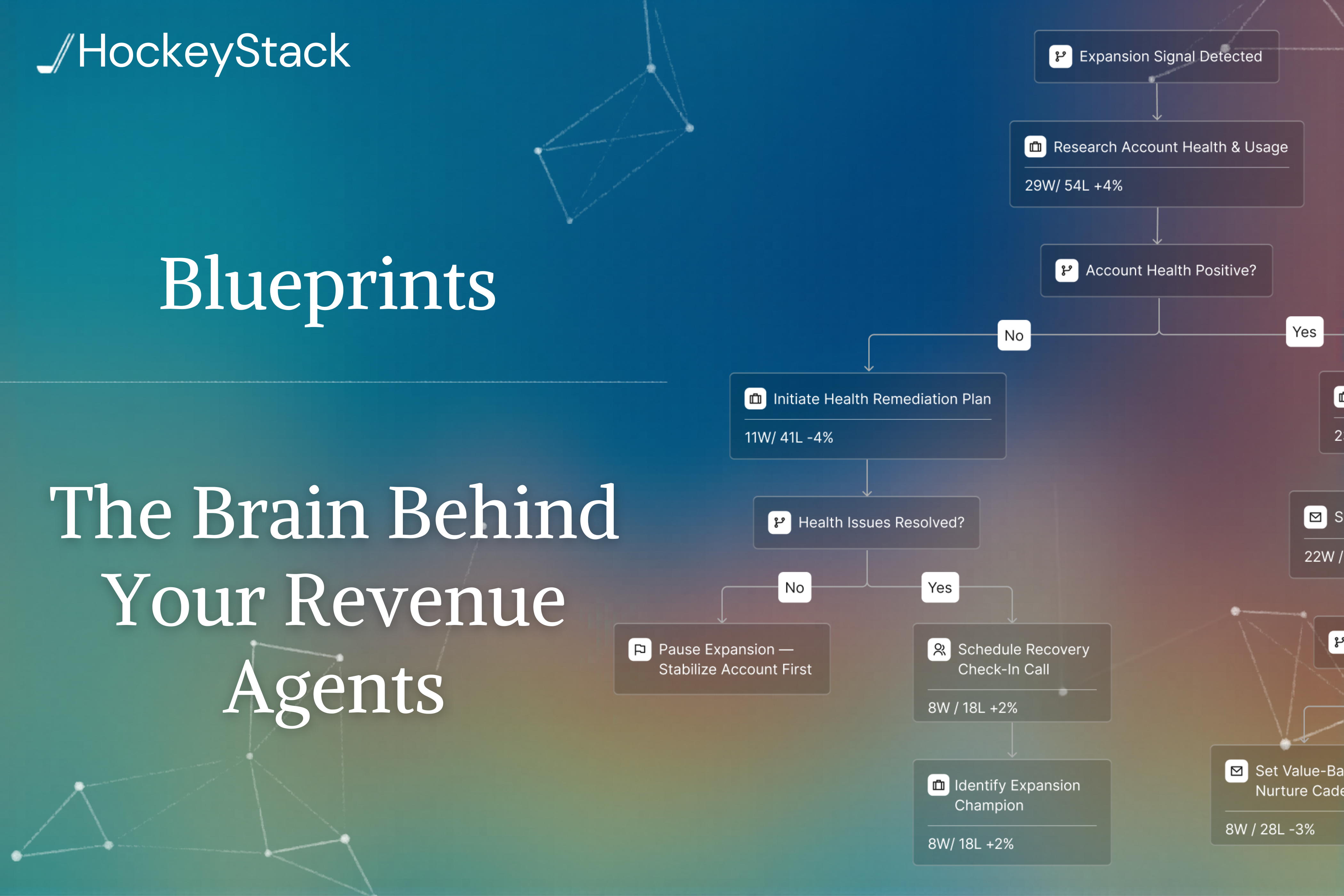
HockeyStack's Blueprint is the brain behind everything. The Blueprint is a machine learning model of how a specific company wins deals, built from every won and lost deal, every touchpoint, and every signal in their historical data. It decodes the patterns that have been successful for this specific company in the past, and finds the statistical next best step to take on every deal. Every action feeds back into the model, which means it gets more accurate over time.
Revenue Agents
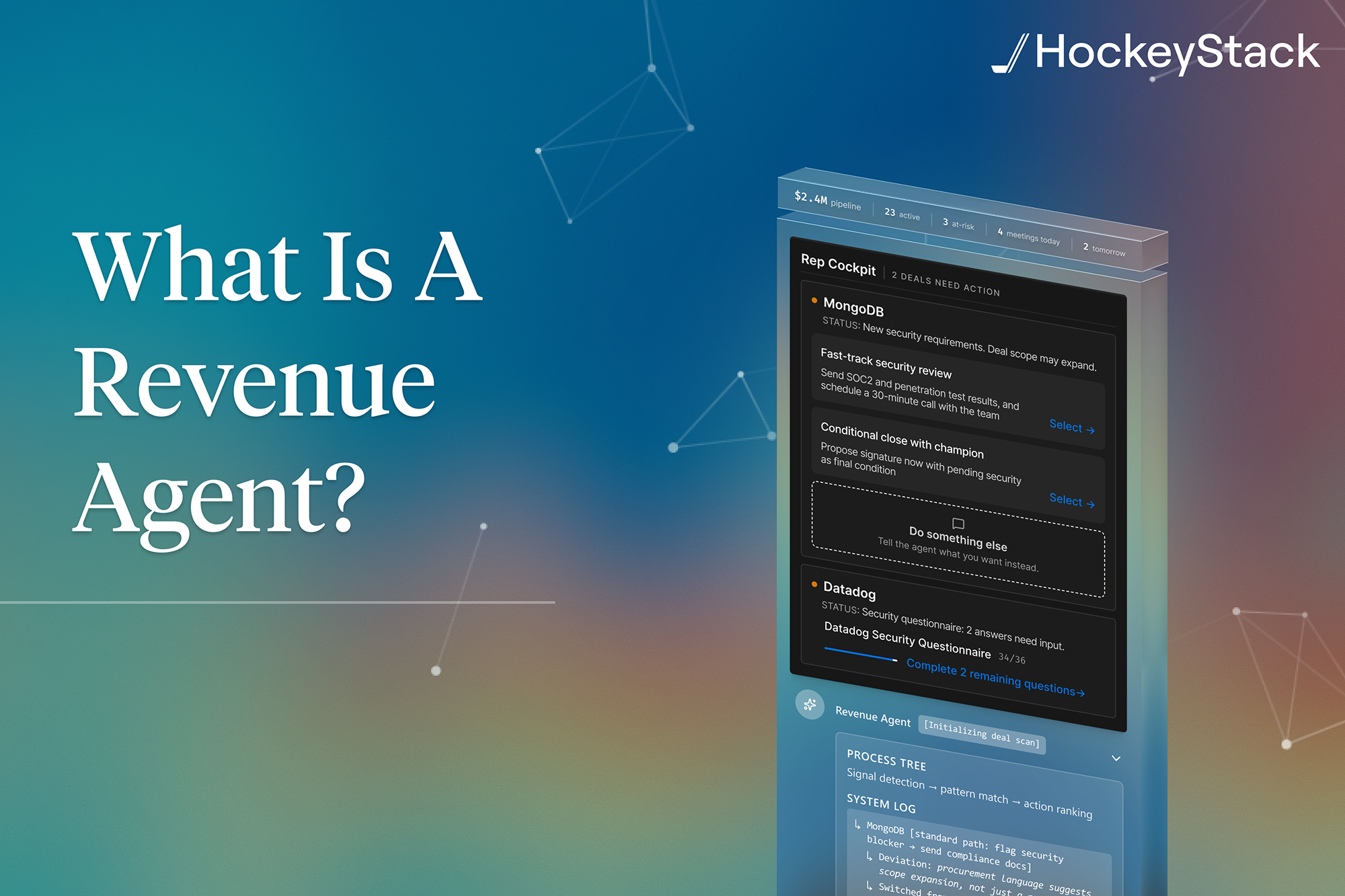
Revenue Agents run autonomously across every deal, with one dedicated agent per account. These agents research accounts, draft outreach, identify stakeholders, monitor signals, and prioritize actions without waiting for the rep to log in and decide what to do next.
Rep Cockpit
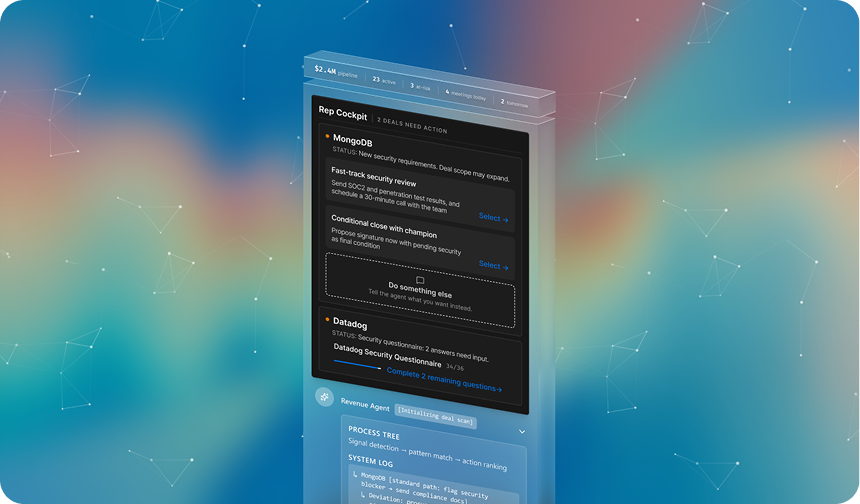
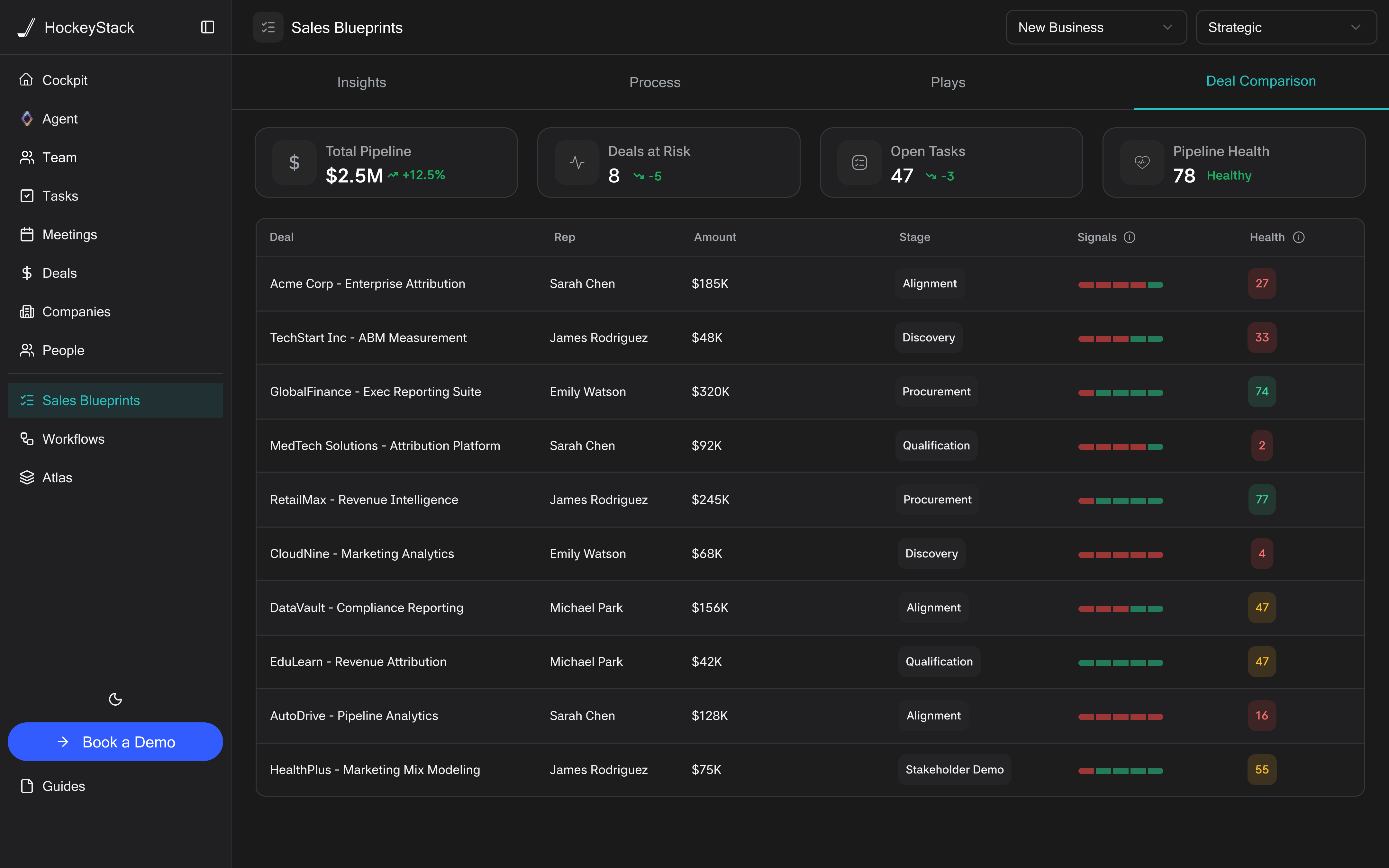
When an action requires a human, the agent surfaces a task in the Rep Cockpit with full context and the reasoning behind it. Every morning, a rep opens Salesforce to a prioritized list of tasks, each tied to the optimal next step the Blueprint recommends for that specific deal. Manager View makes it easy to see exactly when deals deviate from the winning pattern and where reps diverge from ideal behavior, enabling timely and data-driven coaching.
Despite the heavy adoption of AI tools, revenue teams are still facing the same pipeline problems they've been dealing with for years. All AI tools are not built equal, and getting results requires choosing the right ones.
Copilot tools make individual tasks faster but leave the hardest work exactly where it has always been: on the rep. HockeyStack is built on the AI-as-the-brain framework. When AI can strategize, execute, and learn autonomously, reps stop being the connectors between tools and start doing the work that actually closes deals.
Stop adding copilot tools, and start driving pipeline with HockeyStack.
FAQs
How Do I Know If My AI Sales Tools Are Working?
If rep workload has increased since adopting AI sales tools, or if your team is spending more time managing outputs than selling, the tools are not working as intended. The right signal is not whether individual tasks are faster. It is whether pipeline is moving and reps are spending their time on the work that actually requires them. If the answer to both is no, the issue is likely the approach, not the individual tools.
Why Are AI Sales Tools Increasing Rep Workload?
Each new AI tool solves one part of a workflow and hands the output back to the rep. The rep becomes responsible for connecting tools, processing outputs, reconciling signals, and deciding what to do next. The more tools in the stack, the more inputs a rep has to synthesize before they can act. 70% of revenue leaders report that rep workload increases in the first 90 days after a new tool rollout, and 48% say their organization became more complex after adopting AI tools.
What Should AI Actually Do in a Sales Team?
AI should handle the execution work that does not require human judgment: account prioritization, research, outreach drafting, signal monitoring. It should run continuously across every deal and every account, and surface work to reps only when the moment requires a relationship, a negotiation, or a judgment call.
What Is an AI Sales Copilot?
A sales copilot is an AI assistant that helps reps complete tasks faster: drafting emails, summarizing calls, flagging at-risk deals, or suggesting next steps. The rep initiates actions and decides what to do with the AI's output. Copilots are built on the assumption that the human runs the workflow and the AI makes them more efficient.
What Is the Difference Between the AI Copilot Framework and AI-as-the-Brain Framework?
A sales copilot waits for a rep to act and helps them act faster. With AI-as-the-brain, agents execute work on their own: researching accounts, drafting outreach, monitoring signals. The AI loops the rep in only when a human is needed. The difference is who runs the operation. With a copilot, the rep does. With AI-as-the-brain, the system does.
How Does HockeyStack Help Revenue Teams Hit Quota?
HockeyStack replaces the copilot approach with the AI-as-the-brain framework. The Blueprint learns how a specific company wins deals from its own historical data. Revenue Agents execute against that pattern autonomously and continuously across every account, without waiting for a rep to log in and decide what to do. Work reaches a rep only when the moment requires human judgment, a relationship, or a complex decision. The result is consistent execution across every deal, fewer signals going unnoticed, and reps spending their time on the work that actually closes business.
.png)





%20(1).png)