
Product-led Growth Flips the Traditional GTM Playbook
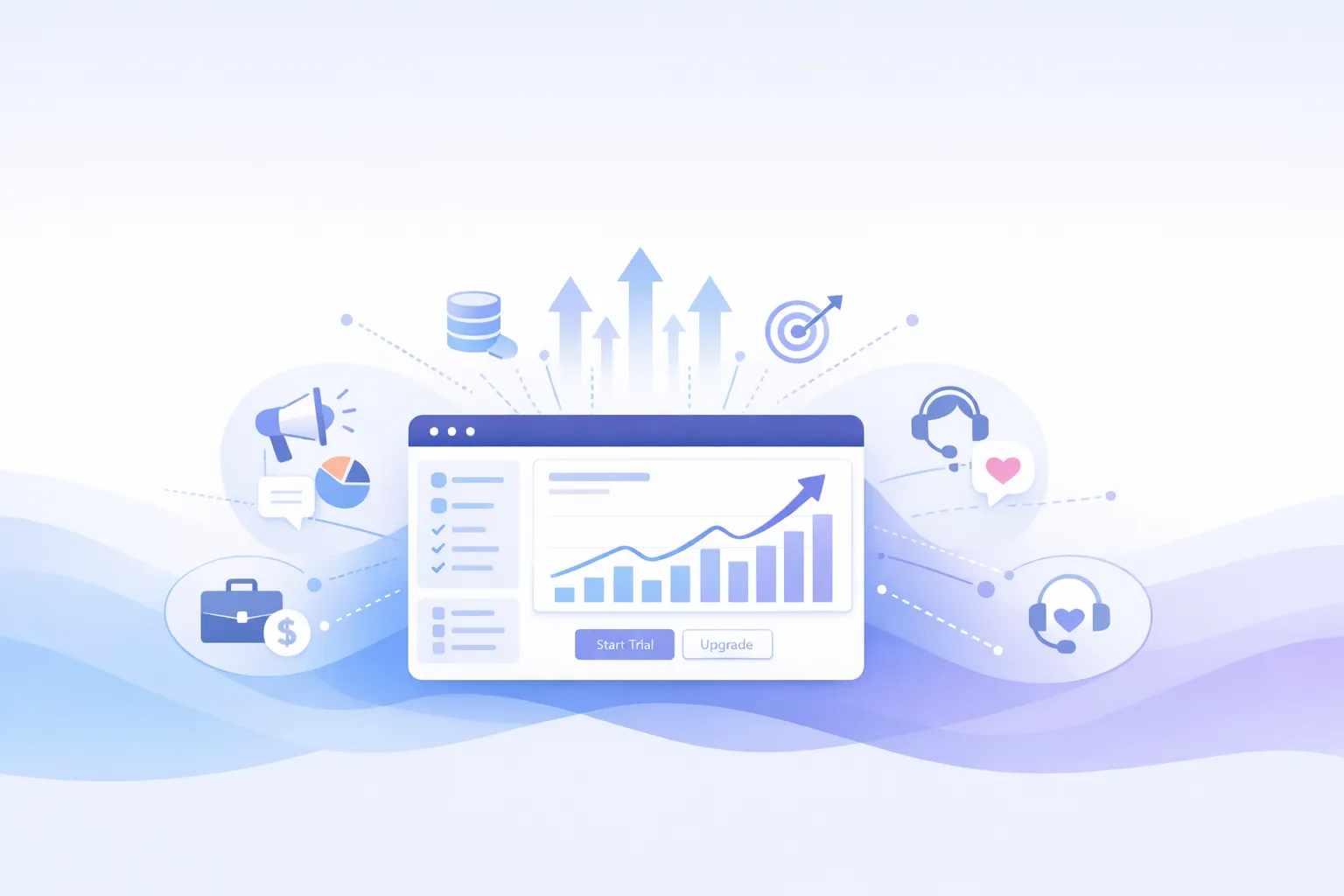
Product-led growth flips the script on traditional go-to-market strategies. Instead of sales reps convincing buyers that your product delivers value, the product proves it directly.
For GTM teams, this shift creates both opportunity and complexity. You gain a scalable acquisition channel that works around the clock, but you also need new playbooks, signals, and ways of coordinating across sales, marketing, and customer success (CS). This guide covers how to build and operationalize a solid PLG motion that turns product usage into pipeline and revenue.
What is product-led growth for GTM teams
Product-led growth (“PLG”) is a go-to-market strategy where the product itself drives customer acquisition, conversion, and expansion. Instead of relying solely on sales reps or marketing campaigns, PLG lets buyers experience the product firsthand before making a purchase decision. So basically, the product does all the heavy lifting when it comes to demonstrating value, while sales, marketing, and CS focus on accelerating and expanding that value once users are already engaged.
- Product-led growth (PLG): A GTM strategy where product usage drives acquisition, conversion, and expansion
- GTM motion: The coordinated approach between sales, marketing, and CS teams to bring a product to market
- Product-qualified lead (PQL): A user or account that shows buying intent through product behavior rather than form fills
- Time to value (TTV): The duration between signup and a user's first meaningful outcome
Product-led growth vs sales-led growth vs marketing-led growth
Every GTM strategy—including product-led, sales-led, and marketing-led—employs a different function to drive pipeline and revenue. Most B2B companies operate with a hybrid approach—the question isn't which one to choose exclusively, but how to blend PLG with your existing sales and marketing motions.
Why GTM teams are adopting product-led growth
The shift toward PLG reflects how B2B buyers now prefer to evaluate and purchase software. They want to try before they buy, and they expect to reach value without waiting for a sales call. In fact, research from Gartner revealed that 75% of B2B buyers say they prefer a rep-free sales experience altogether.
Lower customer acquisition costs
When users experience value without sales involvement, you reduce reliance on expensive outbound motions and high-touch demos. The product becomes a scalable acquisition channel that works around the clock.
Scalable and sustainable growth
PLG compounds over time as active users invite teammates, share workflows, and expand usage organically. Growth doesn't require proportional increases in headcount.
Faster sales cycles with qualified buyers
Users who have experienced the product firsthand and seen its value convert faster when sales reps engagethey've already answered their own objections through hands-on exploration.
Higher retention and expansion revenue
Product adoption correlates directly with retention, since users who build habits around your product churn less frequently and naturally discover reasons to upgrade.
Prerequisites for building a successful product-led GTM motion
Before launching any PLG playbook, you need to have the right foundations in place. Real results come from a combination of:
- Product readiness: The product delivers standalone value quickly without requiring sales assistance
- Data infrastructure: You can capture and unify product usage signals across the entire buyer journey
- Cross-functional alignment: Sales, marketing, and CS agree on definitions, handoff triggers, and shared goals
- Self-serve onboarding: Users have a clear path to value without extensive support
Free trial vs freemium vs demo for your PLG strategy
The right PLG acquisition model depends on both product complexity and user expectations.
When to choose a free trial
Time-limited access works well when value can be quickly demonstrated. Users know they have a window to evaluate the product, which focuses their attention on reaching key milestones before the trial ends.
When to choose freemium
An unlimited free tier makes sense when network effects or viral loops drive growth. The product supports clear upgrade triggers—like usage limits or premium features—that naturally guide users toward paid plans.
When to use a demo model
For complex products where users require a guided setup, a hybrid approach combines hands-on experience with human assistance. Enterprise buyers often expect this white-glove treatment.
How to track product usage data across the buyer journey
One of the biggest barriers to effective PLG is disparate data—the average organization has a whopping 23 tools in their GTM tech stack. However, a tangle of dashboards, reports, and analytics tools make it difficult to execute PLG playbooks, which require clear visibility into user behavior, from the first anonymous visit to conversion and expansion. Specifically, you’ll need:
Anonymous engagement tracking
Capturing website and product activity reveals intent signals early on. You can see which accounts are researching your product even before they sign up.
Account-level activity visibility
The average enterprise B2B buying group consists of 5-11 stakeholders across five distinct business functions. Aggregating individual user actions to the account level is critical to identify buying committee engagement patterns. When multiple stakeholders from the same company are evaluating your product, that's a signal worth knowing.
Cross-system data unification
Consolidating your CRM, marketing automation, product analytics, and customer success data into a single source of truth creates the complete picture necessary for PLG to succeed. Platforms like HockeyStack's Atlas data foundation unify GTM data across systems, revealing an average of 4-6X more touchpoints than CRM-based models alone.
The hybrid approach: Five essential product-led sales playbooks for GTM teams
Effective PLG doesn't mean eliminating sales—it means arming sales with better signals about when and how to engage. How? Through product-led sales playbooks: repeatable motions that combine product signals with sales actions. These include:
- Assist playbook
Sales proactively helps active free users overcome friction and realize value as soon as possible. This playbook is triggered by high engagement but stalled progress. When someone is clearly trying to accomplish something but hitting a wall, a well-timed assist can make the difference.
- Convert playbook
Sales engages free users showing buying signals to convert to a paid account. Triggers include usage hitting plan limits or PQL score thresholds. This is your primary revenue-generating playbook.
- Expand playbook
Sales identifies expansion opportunities within existing accounts based on usage growth. When additional teams or use cases emerge, it signals readiness for broader adoption and larger contracts.
- Consolidate playbook
For accounts with multiple subscriptions or fragmented usage across departments, sales helps consolidate into enterprise agreements. This simplifies billing while increasing contract value.
- Defend playbook
Sales or CS engages accounts showing declining usage to prevent churn. A drop in engagement signals risk that requires proactive intervention before the customer decides to leave.
How to reduce time to value in your PLG motion
Time to value (TTV) is the duration between a user signing up and achieving their first meaningful outcome in the product. Shorter TTV directly correlates with higher conversion and retention.
- Map the critical path: Identify the fewest steps required to reach the first value moment
- Remove friction points: Eliminate unnecessary forms, approvals, or configuration steps
- Guide with in-app prompts: Use onboarding checklists and contextual messaging to keep users on track
- Personalize the experience: Tailor onboarding flows based on user role, use case, or segment
How to identify and prioritize product-qualified leads (PQLs)
There's no universal PQL definition, since every team defines signals based on their specific product and buyer’s journey. However, certain patterns consistently indicate buying intent:
- Engagement depth: Users who complete key activation milestones
- Usage frequency: Consistent return visits indicating habit formation
- Feature exploration: Interaction with premium or advanced features
- Team activity: Multiple users from the same account engaging
- Limit proximity: Approaching usage caps on free plans
The key is identifying which behaviors correlate with actual conversion, then building scoring models around those signals.
Measuring PLG playbook performance and attribution
GTM teams often struggle to measure PLG performance because traditional attribution models miss product-led touchpoints entirely. A user might engage with your product dozens of times before converting, yet those interactions remain invisible in standard reporting. Specifically, you’ll want to look at:
- Playbook conversion rates: Track progression through each playbook stage
- Time to conversion: Measure how quickly PQLs become customers after sales engagement
- Influenced pipeline: Attribute revenue to product usage touchpoints alongside marketing and sales touches
- Expansion and retention metrics: Monitor net revenue retention tied to each playbook
How to align sales marketing and customer success around PLG
PLG fails when teams operate in silos. Marketing generates signups, sales converts PQLs, and CS drives retention—but all three need shared definitions and data to work together effectively. To get on the same page, use:
- Unified funnel definitions: Agree on what constitutes an MQL, PQL, and sales-accepted lead
- Shared data visibility: Ensure all teams can see the same product usage signals and account context
- Coordinated playbook ownership: Assign clear ownership for each playbook while enabling smooth handoffs
- Joint success metrics: Align incentives around revenue outcomes rather than siloed activity metrics
How to turn product signals into pipeline and revenue
PLG playbooks work when GTM teams have the right data foundation, clear playbook definitions, and cross-functional alignment. The goal isn't more data, but actionable insights that drive revenue.
When you can see every touchpoint across the buyer journey, identify PQLs based on real product behavior, and measure which playbooks actually influence pipeline, PLG becomes a repeatable growth engine rather than a buzzword.
For GTM teams ready to operationalize product-led growth with complete visibility across the buyer journey, book a demo with HockeyStack to see how unified data powers PLG playbooks at scale.
FAQs about product-led growth playbooks for GTM teams
How do GTM teams implement PLG when they already have a sales-led motion?
Most B2B companies adopt a hybrid approach by layering PLG playbooks onto existing sales processes. Product signals help prioritize accounts and time outreach rather than replacing sales entirely.
What is the difference between a product-qualified lead and a marketing-qualified lead?
An MQL demonstrates interest through marketing engagement like content downloads or webinar attendance. A PQL demonstrates intent through actual product usage and activation behavior.
How long does it take for GTM teams to see results from PLG playbooks?
Results depend on sales cycle length and data maturity. Teams typically begin identifying PQLs within weeks of implementing product tracking and see measurable conversion improvements within one to two quarters.
Can enterprise B2B companies with complex products use product-led growth?
Yes. Enterprise companies often use PLG for land-and-expand strategies where individual users or teams adopt the product before sales engages decision-makers for broader rollouts.
How should GTM teams attribute revenue to product-led touchpoints?
Multi-touch attribution models that include product usage events alongside marketing and sales touches provide the most accurate view of which signals influence pipeline and closed revenue.