
Best AI-Powered GTM Solutions in 2026 and Beyond


Summary:
- Marketing attribution technology has matured and evolved into full-scale GTM AI platforms which capture revenue data, analyze buyer journey trends, and consolidate predictive insights across go-to-market teams.
- When evaluating solutions to measure and optimize buyer’s journeys, it’s critical to distinguish between ad hoc automation and true GTM AI, which uses unified revenue data to actually forecast conversions before they occur.
- This comprehensive guide details 10 standout AI-powered GTM platforms, based on a deep analysis of dozens of solutions, case studies, and customer reviews on G2 and Reddit.
- HockeyStack is a GTM AI intelligence platform that combines revenue data unification, predictive insights, and workflow automation, granting teams unprecedented visibility into B2B buyer’s journeys.
For the last decade, every GTM problem came with the same prescription—just buy another tool. Lousy data enrichment? Get ZoomInfo. Need ABM? Demandbase has entered the chat. Marketing ops broken? Try HubSpot.
Next thing you know, you're stuck with a "Franken-stack"—a sprawling mess of tools that each own a slice of the buyer’s journey, but nobody sees the full picture. Marketing can't prove ROI, sales lack context, and RevOps spends all day cleaning data. The breaking point is here: fewer than 30% of companies have fully integrated GTM tech stacks.
AI should have been the remedy, with its ability to streamline even the clunkiest of GTM engines. The facts on the ground tell a different story: While three in four GTM leaders report top-down pressure to adopt AI, more than half (53%) of GTM leaders see either no impact or limited impact from it.
And that’s the thing: not all AI is created equal. There’s a difference between ad hoc automation and purpose-built GTM AI platforms. The former just adds more clutter to your tech stack, while true GTM AI unifies revenue data, runs deep analysis, and executes workflows specifically built to optimize your pipeline performance. How do you spot the difference?
That’s where this trusty guide comes in.
You’ll learn:
- What are true GTM AI platforms (and what sets them apart from general-purpose AI)
- Why GTM AI is essential for success
- Key features to look for in true GTM AI platforms
- The best GTM intelligence platforms for marketing teams in B2B
Let’s jump right in!

What Are GTM AI Platforms?
GTM AI platforms are a new category of AI tools that connect all your revenue data, analyze trends across the buyer’s journey, and automatically coordinate actions between your revenue teams. Unlike surface-level automation or legacy platforms with bolted on AI features, true GTM AI platforms were built from the ground up to support pipeline and revenue growth. These platforms typically offer three core capabilities:
- Unified GTM data: GTM AI platforms integrate all your go-to-market tools (CRM, email platforms, ad networks, marketing analytics, etc.) and consolidate every data source to form a complete, centralized view of the buyer’s journey.
- Centralized intelligence and deep analysis: With all your revenue data consolidated in one place, GTM AI platforms can detect patterns and surface insights that channel-specific tools miss—like cause and effect between touchpoints, which interactions influence deal sizes, and what early signals predict churn. You get insights across the entire funnel.
- Agentic GTM workflows: True GTM AI platforms offer deeper functionality than general automation or superficial outputs. They can execute autonomous, multi-step workflows and make contextual decisions to improve pipeline performance, like updated lead scoring in your CRM or launching a targeted email sequence based on real-time buyer behavior.
Why GTM AI Is Essential to Success
Five years ago, you could dominate your market with a solid product and a well-executed playbook. Those days are over. Now, buyers research in stealth mode, data exists in 20 different systems, and every board meeting demands proof of ROI down to the penny. Running modern GTM with legacy systems is like delivering packages on horseback while your competitors deploy an army of drones. Here's why:
Your Buyer Is Now in Control (and Anonymous)
Buyers are now firmly in the driver’s seat and control their own journeys. They research anonymously across review sites, social media, and your competitors' content. In fact, 75% of B2B buyers say they prefer a rep-free sales experience. By the time they fill out your contact form, they've already made their decision. According to Forrester Research, 90% of the buyer’s journey is complete before a prospect reaches out to sales.
Legacy systems—with disparate data sources and siloed dashboards—struggle to effectively connect the dots as buyers engage anonymously across multiple campaigns and channels.
GTM AI platforms can pick up buying signals from real-time buyer behavior across touchpoints and show you which accounts are in research mode before they formally raise their hands.
Buyer’s Journeys are Sprawling—And the Data Right Along With It
Buyer’s journeys aren’t just increasingly anonymous, but expansive. On average, 13 people are involved in the buying decision, with 89% of purchases involving two or more departments.
The average enterprise B2B buying group represents five distinct business functions.
Our own research also found it takes significantly more exposure to close a B2B deal now compared to just two years ago. The average company now requires 2,879 impressions and 266 touchpoints—a 20% increase in touchpoints and 9.5% increase in impressions since 2023. If opportunities reach or exceed $100K in ACV, the average number of impressions skyrocket to nearly 5,500 and touchpoints to 417.
To effectively engage accounts and individual buyers, the average B2B company now runs five core GTM channels—each frequently requiring its own dedicated platform or analytics tool. Every tool generates thousands of data points daily—CRM activities, website visits, ad impressions, product usage, and email opens. This leads to inevitable data sprawl:
- The average GTM enterprise team pulls data from 23 sources.
- Two-thirds of marketers say they use 16 or more tools, often for overlapping functions like email, content management, analytics, and segmentation.
- Marketers are using just 33% of their tech stack’s capabilities.
Even the most capable GTM team will struggle to connect a LinkedIn ad impression to a closed-won enterprise deal six months later—especially if they’re making do with legacy systems, spreadsheets, and siloed dashboards across multiple tools. GTM AI platforms handle this complexity by processing data from all sources simultaneously, revealing exactly how each touchpoint contributes to pipeline and revenue.
💡PRO TIP: Integrate your GTM tools instantly with HockeyStack's no-code integrations. While traditional platforms require weeks of API setup, HockeyStack lets you connect Salesforce, HubSpot, LinkedIn Ads, and your entire martech stack with just a few clicks.
"Good Enough" is No Longer Enough
The stakes for GTM performance have never been higher. Teams are expected to deliver more revenue with less budget, while proving the ROI of every decision—64% of CMOs say their top challenge is proving marketing's value to the business.
Rough estimates and monthly reports simply aren’t enough anymore. You need real-time data, reliable forecasts, and ongoing optimization. GTM AI platforms show which accounts are actually in-market—freeing teams from manual data entry and reporting—and reveal the true ROI of every GTM investment.
Learn more → What is GTM AI?
Key Features to Look for in GTM AI Platforms
We've watched too many teams buy “AI-powered tools” that turned out to be nothing more than glorified ChatGPT wrappers with CRM integration. There are currently over 15,000 MarTech solutions on the market, and 77% of new products added in the last year were AI-native. So how do you cut through the noise and determine the best AI marketing attribution software?
The platforms that do deliver real results have a few specific features in common. Here’s a checklist of five key features to look for:
Predictive Analytics for Data-Driven Decision-Making
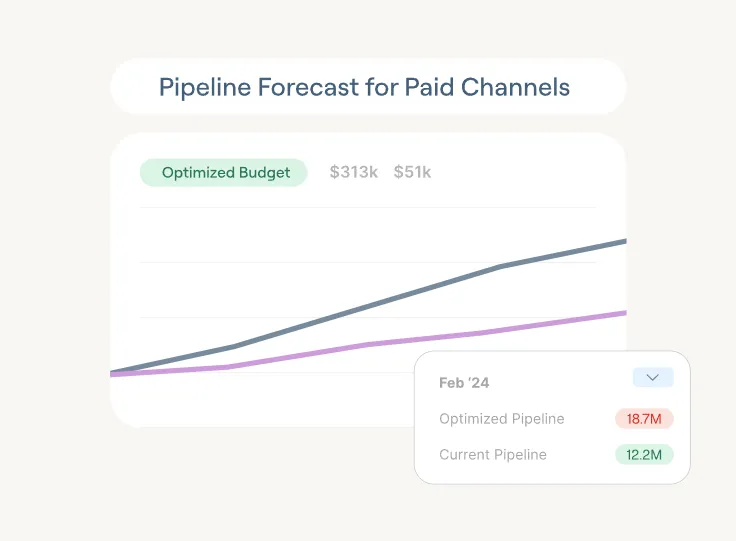
There’s a difference between data and actionable insight. True GTM AI platforms don’t just consolidate revenue data sources. They analyze patterns, trends, and real-time buyer behavior to predict what’s coming next—which leads will close, which investments will pay off, and who's about to churn.
This intel enables sales reps to focus their time and attention on winnable deals, marketers to double down on campaigns and channels actually driving pipeline, and customer success managers to salvage at-risk accounts while there’s still time to make a difference. No more guesswork or chasing dead ends
💡PRO TIP: Let HockeyStack's AI study your winning deals to automatically score your pipeline. It learns what your best customers did before buying — which pages they visited, how long they researched, what content they downloaded — then finds similar patterns in current prospects.
Deep and Seamless Integrations
GTM AI platforms use deep integration to pull data together across the entire GTM tech stack, including your:
- CRM
- Website
- Marketing automation platforms
- Ad platform
- Product
This should happen automatically, in real-time—no more CSV exports or broken API connections. When data flows freely between systems, your teams are freed from manual drudgery and can focus more on high-value work that yields tangible results.
High-Quality Personalization at Scale
Your buyers hate generic outreach, but your team can't write custom content for thousands of accounts. GTM AI platforms close this gap, personalization messages for each prospect by company size, industry, where they are in the buying process, and what content they've consumed.
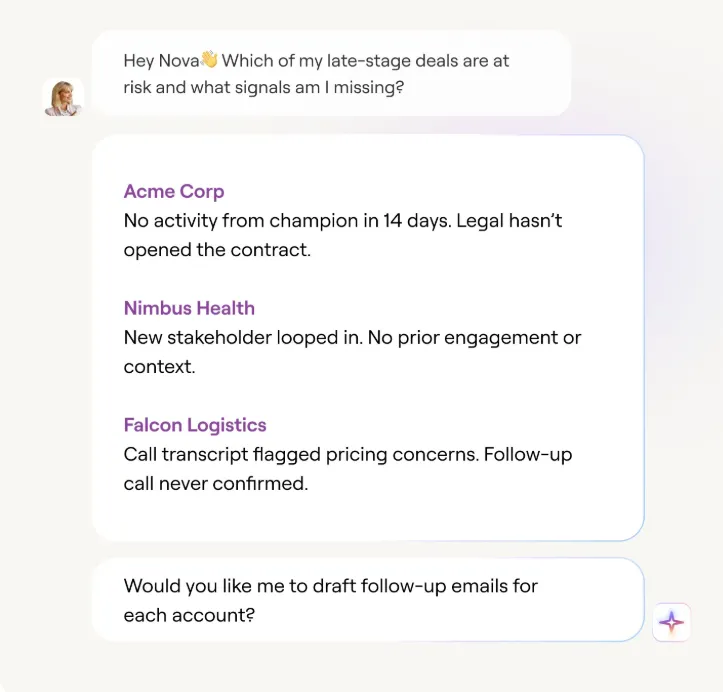
💡PRO TIP: Nova AI tracks real prospect behavior (reading blog posts, evaluating competitors, or perusing the pricing page), then writes outreach referencing these specific actions. This happens for thousands of prospects automatically, instead of costing reps hours per prospect on personalization.
End-to-End Automation & Agentic Workflows
End-to-end automation and multi-step agentic workflows essentially enable your GTM machine to run itself. When someone visits your pricing page, for example, a true GTM AI platform will enrich and score the lead, route it to the appropriate rep, create a follow-up sequence, and personalize the first three emails. If the prospect doesn't respond, it will fine-tunes the approach. If they engage, it books the meeting. Your team handles strategy and relationships, not data entry and manual tasks.
Other agentic GTM workflows may include:
- Creating a recommended list of actions and talking points to engage target accounts
- Generating weekly win/loss reports with patterns, insights, and recommendations for leadership
- Preparing pre-call briefs and deal-specific battlecards with key differentiators to emphasize and potential objections to prepare for
- Analyzing marketing spend efficiency across channels, then generating budget reallocation recommendations
True GTM AI is the difference between random acts of AI and equipping your team with a revenue command center that learns from, adapts to, and optimizes its own pipeline.
💡PRO TIP: Build cross-functional workflows in HockeyStack that trigger actions across your entire stack. When someone visits pricing, the platform enriches their data, updates Salesforce, alerts the rep in Slack, launches LinkedIn ads, and sends personalized emails automatically.
The Best AI-Powered GTM Solutions on the Market Right Now
Nowadays, every GTM vendor is eager to showcase their AI capabilities. But when you test them, only a handful go beyond basic automation. That’s why we dug deeper when we examined the most popular AI analytics tools for B2B marketers.
Our method:
- Analyzing dozens of platforms
- Scouring hundreds of G2 reviews (especially the brutal ones)
- Combing through Reddit threads where users divulged what actually happens post-purchase
Our mission: Discovering which platforms deliver on the full GTM AI promise—unified data, predictive insights, and end-to-end automation. Some platforms nail all three, others are strong in specific areas but need other tools to complete your stack. We'll break down exactly what you're getting with each:
1. HockeyStack
B2B organizations looking for true end-to-end GTM AI that handles data collection, attribution, predictive insights, and agentic workflows in a single system.
HockeyStack is a complete GTM AI platform that unifies your data sources, delivers intelligent recommendations, and executes cross-functional workflows across departments.
With our two AI agents — Odin for analysis and Nova for execution — you get a self-improving GTM revenue engine that picks up on your winning patterns and scales them.
What makes HockeyStack different is that it's one of the only platforms that handles the entire GTM workflow.
Most vendors pick one thing to do well — maybe revenue attribution, maybe automation, maybe analytics. But you still need to stitch together multiple tools to run your complete GTM motion. HockeyStack does it all in one platform.
Key features
- Odin AI analyst: An embedded AI analyst that answers complex GTM questions, delivers insights with visualizations, and recommends next best actions to take. You can ask Odin to find top-performing campaigns, what content to create next quarter, or prepare your board meeting doc.
- Nova AI assistant: AI rep assistant that studies your best customers and top-performing reps to recommend what you should do next, researches accounts automatically, scores prospects based on their buyer journeys, and builds workflows that handle sales tasks for you.
- Unified GTM data platform: Connect all your GTM tools into one system that becomes your single source of truth. Website visits, ad clicks, email opens, CRM platform — everything flows into HockeyStack so teams stop arguing about whose data is right.
- Multi-touch attribution: Choose from 9 attribution models to see how every touchpoint contributes to revenue, from first click to closed deal. You can track the impact of campaigns, content, offline events, and more across the complete buyer journey with full accuracy.
- GTM workflow automation: Orchestrate end-to-end workflows that combine first-party and third-party audiences, enrich data, and launch campaigns directly within HockeyStack.
What do real users like about HockeyStack
“HockeyStack’s Odin has been a game-changer for our team. As a team of one, Odin acts like an additional analyst for the team and can answer tactical day-to-day questions.
Data-driven insights and recommended actions that would take days to generate are produced in minutes, allowing the greater flexibility to make adjustments quickly. This has opened up bandwidth to focus on strategic changes to our GTM and marketing strategy.”
[G2 Review, Cody R.]
What customers are saying about HockeyStack
Airbyte is a data movement platform that helps enterprise companies centralize and sync data from hundreds of sources.
Before HockeyStack, Airbyte's GTM team was stuck with an attribution tool that looked great on paper but fell apart in practice. The platform had constant technical issues and couldn't handle its complex enterprise sales cycles.
With multiple decision-makers involved in every deal, they couldn't track how prospects moved through the buyer journey. The team couldn't see the full journey across complex buying committees, and they had to wait on other teams to get basic insights from dashboards.
After switching to HockeyStack, Airbyte transformed how they run GTM:
- Marketing operates independently with self-serve AI insights: The team builds reports and analyzes campaigns without help from data engineers or RevOps.
- Weekly AI reviews drive instant action: The team pivots campaigns and adjusts spend based on what Odin shows them each week.
- Everyone works from the same data: Sales, RevOps, and Marketing finally agree on what's working because they all see the same numbers.
- Budget decisions based on results: They reset budgets quarterly based on actual ROI, not last year's spreadsheet or office politics.
Here's what Mario Moscatiello, Head of Growth at Airbyte, shared about their experience:
“I think Odin is kind of like the analyst I wish I had on the team. I can just sit, have coffee, and really see at a 360-degree level what’s working and what’s not working. It’s been a game-changer.”
2.HubSpot Breeze Intelligence
Best for: HubSpot users looking to add AI-powered buyer intent and data enrichment to their existing CRM workflows, without switching tools.
Breeze Intelligence is HubSpot's AI-driven data enrichment tool that taps into over 200 million company and buyer profiles to automatically fill missing CRM data and outline buying intent signals.
Key features
- Automatic data enrichment: Automatically updates CRM records with details like annual revenue, industry classification, social media links, and technology usage without manual research.
- Form shortening: Pre-fills your forms with data it already knows about visitors to create shorter, simpler forms that have better conversion rates. When people return to your website, Breeze fills in their information automatically so they don't have to type as much.
- Intelligence tab integration: Puts all enriched data and insights in one dedicated tab within HubSpot CRM, where you can see contact and company information, website activity, and buyer intent signals in a single view.
What do real users like about HubSpot Breeze Intelligence
“I've always found data enrichment from HubSpot (via Clearbit) was fairly accurate and useful for enriching target accounts for prospecting. Reports with Breeze are helpful if you want to pull moderately standard reports or create basic reports that can be updated easily to fit a custom implementation. As a HubSpot Solutions Partner, I'm in HubSpot every day, and the minor things, like writing a custom property or workflow description, save me minutes at a time, which add up to dozens of hours of small tasks. I'd say that if you're looking for efficiency in managing HubSpot, there's enough value in Breeze to make it worthwhile.”
[Reddit]
What do real users dislike about HubSpot Breeze Intelligence
“Pretty lame in my opinion. I was excited about the Content Remix AI feature in Content Hub, and was sorely disappointed. Same thing with Breeze. I tried to have it write me an email response to a client, and I didn’t like it at all because it sounded robotic and stuffy.”
[Reddit]
Pricing
Breeze Intelligence is available as a credit-based add-on for any paid HubSpot subscription. The included credits vary by tier:
- 500 credits for Starter
- 3,000 for Professional
- 5,000 for Enterprise plans
3. Salesforce Einstein
Best for: Enterprise companies looking to enhance their Salesforce instance with AI features.
Salesforce Einstein is an AI layer embedded across the entire Salesforce platform that brings predictive analytics, machine learning, and generative AI features to revenue teams.
It analyzes your CRM data to automate tasks and predict outcomes without any data science expertise.
Key features
- Einstein conversation insights: Listens to your sales calls to see what works and catch competitor mentions. It transcribes everything and instantly drops call summaries right into Salesforce.
- Einstein activity capture: Syncs your emails and calendar events with Salesforce automatically, so your CRM stays current without manual updates. Einstein also spots new contacts and opportunity roles from your email and calendar activity and adds them for you.
- Einstein for marketing: Gives you AI insights to nail your content and timing for marketing campaigns. It helps you write email subject lines and body copy, plus it scores how likely potential customers are to respond to your messages.
What do real users like about Salesforce Einstein
“The good parts of it are that there’s email syncing to potential leads, contacts, accounts, and opportunities does work well with zero user effort, and you can see threaded conversations. It’s also free for 100 users. So if you just want it to make client emails visible within Salesforce, it's fine.” [Reddit]
What do real users dislike about Salesforce Einstein
“It’s frustrating that activities can’t be read by platforms using native CRM integrations. Our ABM platform reports that the sales team is sitting on their backsides as there are no sales activity records to pull in.” [Reddit]
Pricing
Einstein AI features typically cost $50/user/month for most clouds, though Agentforce for Service runs $125/user/month. If you're on Salesforce Unlimited Edition, many Einstein features come included, while Enterprise Edition users need to add them as paid extras.
4. Gem-E by UserGems
Best for: B2B companies that want to leverage warm connections and buying signals instead of relying solely on cold outbound prospecting.
Gem-E is an AI assistant from UserGems that monitors relevant buying signals to tell sales teams who to contact and when. It pulls data from your CRM to write relevant outreach that references past conversations and shared history.
Key features
- Buying signals tracking and warm lead generation: Automatically tracks relevant buying signals (such as when your customers change jobs), then surfaces them as new leads with updated contact information and relationship context for warm outreach.
- Signal-based prospect prioritization: AI prioritizes accounts and buyers based on person-level and company-level buying signals.
- AI-powered personalized outreach: Scans your CRM for past engagement data and combines it with buying signals to draft email sequences, call scripts, and LinkedIn messages.
What do real users like about Gem-E
“The automation is a game-changer. It tracks champions as they move companies, syncs seamlessly with Salesforce, and alerts me when they land at a new account. It’s like having a prospecting assistant that never sleeps.” [G2 Review]
What do real users dislike about Gem-E
“I do wish the platform had a slightly better way to filter leads based on specific criteria. Sometimes it can be a bit overwhelming with the amount of data, and it would be great to have more granular control over the search function. Also, while the data is generally accurate, there have been a few instances where information was slightly outdated.” [G2 Review]
Pricing
UserGems offers three tiers:
- Core at $30K/year ($2,500/month)
- Advanced at $51K/year ($4,250/month)
- Elite at $72K/year ($6,000/month)
All plans include Gem-E's core AI capabilities like list building, prioritization, and automated campaigns.
There is a one-time implementation fee ($3K-$10K depending on the plan). Startups with under 80 employees can ask about special Starter pricing.
5. Clari
Best for: Enterprise revenue teams that want centralized sales forecasting, pipeline management, and deal intelligence in one platform.
Clari is an AI-powered revenue operations platform that pulls data from all your business systems to give you a clear view of what's happening across your GTM motion. It helps revenue teams build stronger processes, spot pipeline risks and opportunities, and create accurate forecasts.
Key features
- AI-powered revenue forecasting: Uses machine learning to analyze historical data and current pipeline activity to bring forecasts that companies can explain in boardroom presentations.
- Complete pipeline inspection: Shows you exactly how deals are progressing in real-time, flags opportunities that might slip, and outlines pipeline gaps before they hurt your quarterly results.
- Cross-functional revenue alignment: Unifies data from CRM, email, calendars, and other revenue systems to create a single source of truth that sales, marketing, and customer success teams can rely on.
What do real users like about Clari
“Clari has been immensely helpful. It makes forecasting so much simpler and brings everything together. We used to do everything in clunky Google Sheets. But now, with Clari, it's all in one spot. It's incredibly easy to keep an eye on forecasts, pipeline changes, and how we're performing overall, all in real time.
The Inspect module has been a great, flexible tool for our team. We can easily break down the data by product, customer segment, or region, and update all from one tab. Having that kind of visibility and organization has made our forecasting calls way more productive, and we're much better informed.” [G2 Review]
What do real users dislike about Clari
“I find Clari occasionally frustrating as it sometimes deletes all my progress when writing sequences. This unexpected loss of work has forced me to adapt and be more cautious while using the tool. Although I've gotten better at handling it, the issue remains a concern.”
Pricing
Custom quotes based on your needs. Larger companies get full implementation support and dedicated customer success teams.
6. Copy.ai
Best for: Marketing and sales teams who want to automate content generation and GTM workflows without building custom AI solutions from scratch.
Copy.ai is a GTM AI platform that consolidates all your disconnected GTM data and builds automated workflows to sync up sales, marketing, and customer success.
Key features
- AI workflow builder: Teams can codify their best GTM playbooks into repeatable, cross-functional processes that automate complex workflows from lead qualification to deal coaching.
- Content creation engine: Generates SEO content, sales email campaigns, social media posts, and marketing materials in seconds using your brand voice and company data.
- Cross-platform integrations: Connects with 2,000+ apps, including Salesforce, HubSpot, and Zapier, plus supports multiple AI models like OpenAI and Anthropic.
What do real users like about Copy.ai
“From a sales process perspective, I'm able to orchestrate workflows to enrich data on prospects, accounts, and more, enabling us to personalize automated inbound emails. We can also equip our SDRs with highly specific research that's relevant to our market, so they don't have to start from scratch when researching new accounts.”
[G2 Review, Brian Y.]*
What do real users dislike about Copy.ai
“Sometimes it's pretty clear that AI-generated content lacks the human touch or nuance that some users desire. Plus, the customization options within each template might be limited for users seeking more specific or niche writing needs.”
[G2 Review, Divyanshi T.]*
*Note: Copy.ai’s G2 page has been removed, at time of update.
Pricing
Copy.ai offers both self-serve and enterprise options:
- Free: Limited access with 1 seat, 2,000 words in chat, and basic features.
- Starter: $49/month for 1 seat, unlimited words in chat and chat projects, plus access to all the latest LLMs.
- Advanced: $249/month for up to 5 seats, includes 2k workflow credits/month, 15+ marketing and sales workflows, and Workflow Builder access.
- Enterprise: Custom pricing with guided implementation, unlimited workflows, API access, bulk workflow runs, and customer support team.
7. Demandbase
Best for: Enterprise B2B companies with large marketing budgets who need comprehensive account-based marketing and sales alignment across complex buying cycles.
Demandbase is the leading account-based GTM platform for B2B enterprises. It combines intent data, AI insights, and multi-channel orchestration to align sales and marketing around account-based go-to-market strategies.
Key features
- Coordinated sales and marketing orchestration: Automates personalized actions across every channel and aligns sales and marketing teams with a single view of account activity.
- Cross-channel advertising: Runs targeted B2B advertising campaigns across display, social, and connected TV to reach buying committees wherever they research.
- Account Intelligence engine: Connects 1st, 2nd, and 3rd-party data into a single account view that shows which accounts are in-market based on intent signals, website visits, and customer engagement patterns.
What do real users like about Demandbase
“I've used Demandbase at a few companies I've worked at, and it has truly transformed our account-based marketing efforts. The platform’s cutting-edge targeting capabilities and AI-powered insights have enabled us to pinpoint high-value prospects with unprecedented accuracy. Integrating seamlessly with our CRM and marketing automation tools, Demandbase makes it easy to create and execute personalized campaigns that resonate with our target audience.”
[G2 Review, Jen B.]
What do real users dislike about Demandbase
“Sometimes the AI isn't as updated as I would want it to be. Also, the information on companies isn't updated, so it makes it hard to do my job, and I have to double-check my information before reaching out.”
[G2 Review, Tammy V.]
Pricing
Demandbase doesn't publicly publish its pricing. They customize it for each enterprise customer. You'll need to talk to their sales team to get a quote based on your specific needs.
Learn more → 6sense vs. Demandbase: 2025 Comparison (+ Better Options)
8. 6sense
Best for: Large B2B companies looking to identify anonymous website visitors and track buying signals across the dark funnel.
6sense is a Revenue AI platform that tracks anonymous website visitors to show which companies are actively researching solutions. It analyzes over one trillion daily signals to predict purchase intent and tells sales teams exactly when prospects are ready to buy, even before they fill out forms or contact you.
Key features
- 6AI predictive modeling: Cleans and organizes your account data automatically, then scores each account based on how likely they are to buy and where they are in their journey.
- Intent signal detection: Tracks what companies research across the web to spot who's looking for solutions like yours, even if they've never visited your site.
- Conversational Email AI: Writes personalized emails for each prospect and handles the back-and-forth automatically.
What do real users like about 6sense
“What I like best about 6sense Revenue Marketing is how it empowers marketing and sales teams with actionable insights across the entire buyer journey. Its ability to uncover hidden demand, identify in-market accounts, and prioritize the right prospects makes it far easier to focus efforts where they’ll have the greatest impact.
The AI-driven predictions, intent data, and real-time engagement tracking help drive smarter, more personalized campaigns, ensuring alignment between sales and marketing while accelerating pipeline and revenue growth.”
[G2 Review, Connor H.]
What do real users dislike about 6sense
“Getting started with this platform has been a bit of a learning curve—it’s not the most intuitive system out of the box. We leaned heavily on manuals and guides in the beginning. While some features are well-developed, others could use some refinement, and there’s potential for it to become even "smarter" down the line. For instance, it would be great if triggering conversational emails could incorporate data decision splits rather than relying solely on reports.”
[G2 Review, Vera A.]
Pricing
6sense has a free plan that gives you 50 data credits monthly, plus basic company search, alerts, and list-building features.
Their paid tiers include "AI-Powered Sales Intelligence + Data Credits," which adds intent data, technographics, and persona mapping, and "Sales Intelligence + Predictive AI," which brings in AI recommendations and advanced workflow automation.
HockeyStack – #1 GTM AI Platform for Sales and Marketing Teams
HockeyStack tears down the wall between sales and marketing. Instead of arguing over attribution and pointing fingers over missed targets while deals slip through the cracks, both teams are aligned through a centralized command center—operating from the same data, optimizing with the same AI recommendations, and working with real clarity and purpose towards the same goals.
Here’s exactly what you can do with HockeyStack:
- Gain unparalleled visibility into the complete buyer’s journey, with unified GTM data across your entire tech stack (CRM, MAP, ad platforms, website, and more)
- Ask Odin anything about your pipeline performance and get insights with visuals in seconds—whether you want to know which campaigns are driving the most enterprise pipeline, what content to create next quarter, or how to prepare for your board meeting.
- Leverage Nova, which studies your best customers and winning patterns to score prospects, research companies, tell reps exactly who to contact, and write personalized messages.
- Use multi-touch attribution models to measure how each touchpoint contributes to pipeline and revenue—based on real-time buyer behavior.
- Create and launch agentic GTM workflows that automatically enrich customer data, launch campaigns, score leads, coordinate actions, and put pipeline optimization on auto-pilot.
Tired of piecing together insights from 12 different dashboards? Try our interactive demo and see what unified GTM intelligence looks like in action.
FAQs
How is AI being used in GTM in 2026?
Modern AI platforms can now handle complex GTM operations that used to require entire teams:
- Predictive intelligence: Predicts which accounts will buy, when deals will close, and what actions will drive the most revenue
- Cross-functional workflows: Coordinates actions between marketing, sales, and customer experience automatically based on customer behavior.
- Real-time personalization: Adjusts campaigns, scoring, and messaging in real-time based on the prospect’s behavior and stage in the journey.
- Unified data analysis: AI connects data from all your tools to provide insights that span the entire customer journey.
What are some common use cases for an AI-powered GTM strategy?
GTM AI powers three main types of use cases:
- Unification: Connect all your data sources so teams stop arguing about numbers and work from one source of truth.
- Analysis: Find patterns you'd never spot manually, like which touchpoints drive enterprise deals or why pipeline stalls.
- Automation: Executes automated workflows (e.g., score leads, launch campaigns, and alert reps without manual work).
How do the AI algorithms in these platforms actually work?
These platforms use AI and machine learning to study your past customer interaction data and find patterns in what leads to sales.
The AI looks at your historical deals, marketing touchpoints, and buyer behavior to predict which prospects will convert and what actions work best. The more data you give it, the better it understands your specific business.
Are these platforms only for sales and marketing, or can customer success teams benefit?
Customer success teams can get huge value from GTM AI platforms. For example, they can spot accounts that might churn when engagement drops or usage patterns change.
Plus, CS can see the complete customer journey and work with sales and marketing to keep customers happy and streamline account growth.
How does a GTM AI platform work with tools we already use?
GTM AI platforms connect directly to all your existing tools and pull their data together into one unified view. You keep using your CRM, marketing automation, and sales tools exactly like before, but now the AI shows you how everything connects.